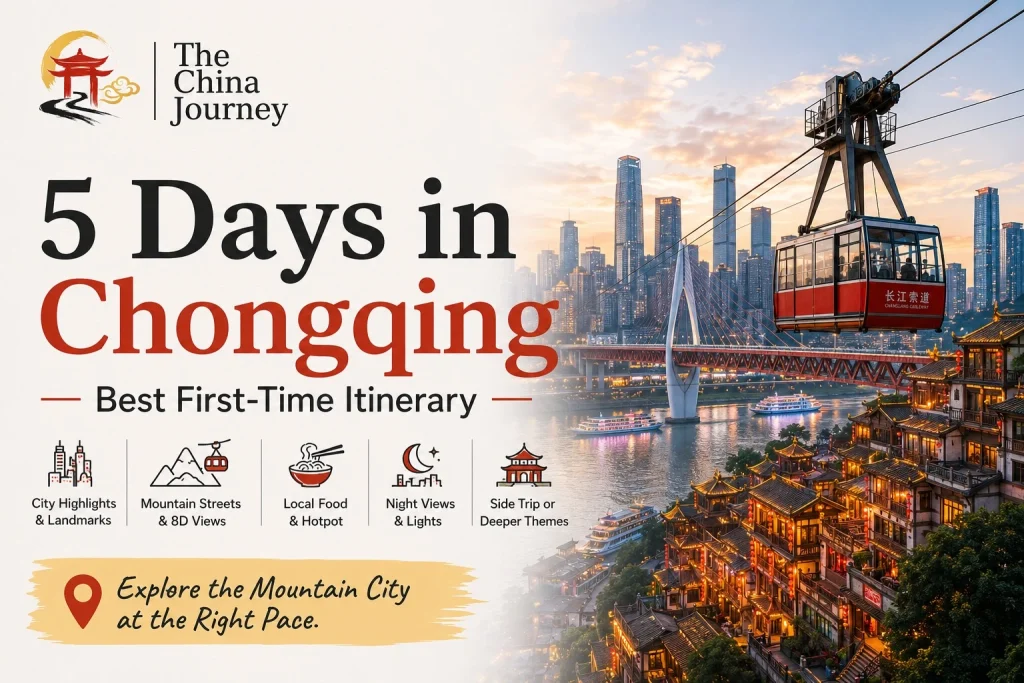
Plan 5 days in Chongqing with city highlights, mountain streets, food, night views, Dazu or Wulong side-trip choices, costs, hotels, and practical tips.
Table of Contents
Quick Answer: How Should You Spend 5 Days in Chongqing?
5 days in Chongqing is ideal for first-time visitors seeking a thorough city experience plus one meaningful extension. It allows a complete core city route without rushing, then dedicates the extra day to either a side trip or a second deeper city theme, following a clear 3+1+1 structure.
Best for: First-time visitors who want a full Chongqing city experience plus one major side trip or second theme day.
Main route logic: Use 3 days for the city core, 1 day for Dazu, Wulong, or a deeper city theme, and 1 day for recovery, missed places, or safe departure.
What you can cover: Core landmarks, river night views, mountain-city streets, vertical transport, local food, cultural areas, art districts, and one wider extension.
What the extra day adds: Real flexibility. You can add one complete side trip or deepen the city route without making every day feel overloaded.
What still needs trade-offs: Do not try to fit both Wulong and Dazu comfortably into 5 days. Choose one, or extend the trip.
Best travel pace: Comfortable but full, with 2–3 main areas or experiences per day.
Main rule: Plan in modules, not by attraction count. Group nearby experiences and use the extra day for one clear upgrade.
Yes, 5 days is sufficient for Chongqing. It covers the city core, allows one major side trip or second urban theme, and provides enough buffer to avoid a rushed itinerary.
Enough for: The main city core, mountain-city streets, night views, food, cultural areas, and one major side trip or second city-focused theme.
Better than 4 days because: You can explore the city and include a side trip without sharp compromises.
Best use of the extra day: Dazu or Wulong, a second urban theme such as food or art, or a true buffer/recovery day.
Still not enough for: A comfortable “city + Wulong + Dazu” route, multiple long hikes, or a slow trip across all districts.
Good for: First-time visitors who want both Chongqing’s city texture and one wider cultural or natural experience.
Who may need more time: Multi-day hikers, travelers linking Chongqing with Chengdu or Guiyang, or slow travelers who want a local-life pace.
Practical judgment: 5 days balances depth and comfort for most first-time visitors.
How to Plan a 5-Day Chongqing Itinerary
Chongqing Shancheng Alley
Plan 5 days in Chongqing as 3+1+1: 3 days for the city core, 1 day for a side trip or deeper theme, 1 day for recovery or missed sites. Focus each day by area and elevation, alternating heavy and light walking.
Plan by area and elevation: Focus each day on one major zone (e.g., Yuzhong Peninsula, Nan’an + Cableway, Shapingba cultural area).
Build the city core first: Days 1–3 should cover landmarks, night views, mountain-city paths, specialty transit, and at least one authentic hotpot meal.
Use Day 4 for deeper theme or side trip: Decide in advance whether it will be Dazu Rock Carvings, Wulong, or a second city theme (food crawl, art, creative districts).
Use Day 5 with purpose: Reserve for light activities, missed attractions, leisurely meals, coffee, shopping, or departure preparation.
Separate high-energy days: Alternate intense walking with museums, cruises, or longer transit.
Protect night-view time: Schedule at least 2 nights with varied vistas (Hongya Cave across the river, Nanshan panoramas, Nanbin Road strolls).
Check reservations and queues: Pre-book tickets and confirm hours for Cableway, Three Gorges Museum (Mon closed), Dazu/Wulong, Huguang Guild Hall.
Keep meals on route: Plan dining along the day’s path; avoid long detours for viral restaurants.
Final day: Reserve 3 hours for flights or 2.5 hours for high-speed rail, including transfers and security.
5 Days in Chongqing Itinerary at a Glance
This table provides a quick overview of how to pace your 5-day Chongqing visit. Each day focuses on a specific theme or area, balancing city core experiences, optional extensions, and a flexible ending. Use it to understand the overall rhythm, energy level, and trade-offs without diving into detailed attractions.
Day
Main Focus
Area Logic
Best For
Pace
Main Trade-Off
1
Classic city first impression & river night view
Yuzhong Peninsula core, landmarks → river
First-time city explorers
Medium-High
Crowds at key spots
2
Mountain-city texture & vertical transport
South Bank + cableway, local streets
Urban explorers & photographers
High
Physically demanding
3
Culture / nature / city-depth theme
Choose one: culture, natural panorama, or local life
Personalized interest & deeper experience
Medium
Cannot do all options
4
Side trip or second deep city theme
Option A: Nanshan / Eling Factory Option B: Dazu Rock Carvings Option C: Wulong Three Natural Bridges
Extension & thematic exploration
Medium-High
Side-trip: longer commute & fatigue; City-depth: miss world-class side sights
5
Flexible ending, missed places, recovery, or safe departure
Short, concentrated areas, hotel surroundings
Relaxed exploration, departure prep
Low
Limited to local/light activities
Best 5-Day Chongqing Itinerary for First-Time Visitors
Day 1: Classic Landmarks and Two-River Night View
Two Rivers Night Cruise chongqing
Day 1 should give you Chongqing’s first strong impression: old dock history, the Yuzhong city core, cliffside streets, and a river night view. Keep the route compact so you can adapt to the terrain instead of burning out on the first day.
Best route logic: Start from the historical core, move to central business areas, and finish with panoramic night views along the river.
Suggested order: Morning at Huguang Guild Hall → walk to Jiefangbei business district for lunch → afternoon Daijiaxiang cliffside route and Kuixinglou “ground floor / high-floor plaza” experience → evening Hongya Cave exterior → walk across Qiansimen Bridge or visit Grand Theatre riverside / Nanbin Road Zhonglou Square for night views.
Transport: Primarily walking + metro + short taxi rides to night-view locations.
Time needed: 8–9 hours.
Reservation / queue note: Huguang Guild Hall requires advance reservation. Hongya Cave interior is commercial; exterior offers a better visual experience. Qiansimen Bridge is free but crowded in peak season.
Best ending: Dinner at a riverside restaurant on Nanbin Road or Jiangbei, or late-night snacks near Jiefangbei.
Watch out for: Avoid overpacking the day; adapt to the hilly terrain. Wind can be strong by the river in the evening.
What not to add: Skip Ciqikou and Liziba on Day 1 to prevent long commutes and fatigue.
Day 2: Mountain-City Walks and Yangtze River Cableway
Jiefangbei
Day 2 is the real mountain-city day. The point is not to add more famous sights, but to feel Chongqing through stairs, slopes, residential buildings, old streets, and the Yangtze River Cableway.
Best route logic: Descend representative trails, visit residential clusters, cross the river via cableway, end at an old street for a relaxed evening.
Suggested order: Morning: Shancheng Third Trail (Zhongxing Road entrance) downhill → visit Baixiangju (24-floor no-elevator building) for photo opportunities → take Yangtze River Cableway from North Station at Xinhua Road to South Station at Shangxinjie → explore Longmenhao Old Street and Xiahaoli Old Street → evening Danzishi Old Street toward “Ten-Mile Light Sea” and dinner.
Transport: High-intensity walking + Yangtze River Cableway + short taxi rides.
Time needed: 7–8 hours.
Reservation / queue note: Pre-book cableway via “Chongqing Cableway Company” WeChat for tickets and queue info; consider reverse route from South Station if lines are long.
Best ending: Dinner at a riverside restaurant in Danzishi with Yuzhong Peninsula night view.
Watch out for: Respect residents at Baixiangju; wear comfortable shoes.
What not to add: Avoid another heavy walking route today; the day is already physically demanding.
Day 3: Culture, Museum, and Ciqikou
Entrance gate of Chongqing Ciqikou Ancient Town
Day 3 slows the pace with culture and history. Use the morning for the Three Gorges Museum, then move to Ciqikou for old dock atmosphere, side lanes, riverside walking, and souvenir shopping.
Best route logic: Morning: structured indoor cultural learning; afternoon: outdoor exploration with historical ambiance.
Suggested order: Morning: Three Gorges Museum (Great Hall of the People exterior) → lunch nearby → Metro Line 1 to Ciqikou Ancient Town for main street and side alleys → evening: Guanyinqiao for local dinner and nightlife.
Transport: Metro primary (Line 2 Zengjiayan, Line 1 Ciqikou).
Time needed: 7–8 hours; museum alone requires at least 2.5 hours.
Reservation / queue note: Three Gorges Museum must be booked in advance; closed on Mondays. Ciqikou is free but crowded; Chen Mahua is recommended as a souvenir.
Best ending: Enjoy a Jianghu-style dinner or hotpot in Guanyinqiao.
Watch out for: Focus on key halls such as “Magnificent Three Gorges” and “Ancient Ba-Yu.”
What not to add: Avoid squeezing in additional large-scale sites; today is already full.
Day 4: Creative Districts, Nanshan, or a Side-Trip Choice
Day 4 is the extension day. Use it for either a deeper city theme or one major side trip. Do not try to combine all options. This is where a 5-day itinerary becomes stronger than a 4-day trip.
Option A: City-depth day – Eling Factory + Nanshan. Start with Eling Factory for cafés, photo spots, and city views. Then take a taxi toward Nanshan Scenic Area. Depending on your energy, add Laojundong or Nanshan Botanical Garden before ending at Nanshan Tree / Yihuali Night Park and the spring-water chicken street.
Option B: Dazu Rock Carvings day trip – Best for Buddhist art, stone carving, and history. It is more cultural and usually easier to arrange than Wulong.
Option C: Wulong Three Natural Bridges day trip – Best for dramatic natural scenery and film-location interest. It is farther, more tiring, and more transport-heavy.
Best route logic: Choose one extension: city-depth, Dazu, or Wulong.
City-depth option: Eling Factory → Nanshan Scenic Area → Laojundong or Botanical Garden → Nanshan Tree / Yihuali Night Park → spring-water chicken dinner.
Side-trip option: Book transport in advance. Dazu is the easier cultural choice; Wulong is the harder natural-scenery choice.
Transport: Taxi works best for the city-depth version. Use bus, train, group tour, or private transfer for Dazu or Wulong.
Time needed: City-depth version: about 8–9 hours. Dazu or Wulong: a full day.
Reservation / queue note: Check tickets, shuttle details, opening hours, and return transport before you go.
Best ending: For Nanshan, finish with dinner and night views. For Dazu or Wulong, return to the city and keep the evening simple.
Watch out for: Return taxis from Nanshan can be difficult on weekends. Wulong is physically harder than it looks on paper.
What not to add: Do not add extra heavy walking or another distant district on this day.
Day 5: Flexible Ending and Departure Buffer
Day 5 allows you to wrap up missed highlights, recover, or prepare for departure. Keep activities light and close to your accommodation or transit nodes.
Best route logic: Flexible, low-effort activities; maintain departure safety buffer.
Suggested order: Morning: Liziba Light Rail Viewing Platform → stroll along Zhongshan Fourth Road → brunch/coffee → pick up souvenirs like Chen Mahua or hotpot base → head to airport/high-speed rail.
Transport: Metro Line 2 (Liziba / Zengjiayan) or taxi for short distances.
Time needed: 3–4 hours.
Reservation / queue note: Liziba platform is free but crowded; plan early for photos.
Best ending: Relax at a café or pick up last-minute local gifts.
Watch out for: Depart 3 hours before flights, 2.5 hours before high-speed rail; do not schedule long-distance or strict-timed activities.
What not to add: No heavy walking, distant excursions, or timed events; prioritize comfort and safety.
Should You Add a Side Trip to a 5-Day Chongqing Itinerary?
5 days is the first comfortable length where one major side trip from Chongqing makes sense. Compared with a 4-day trip, you can still keep a solid city-core experience while using one full day for a wider cultural or natural extension. The key rule is simple: choose one. Do not try to force both Wulong and Dazu into a standard first-time 5-day Chongqing itinerary.
Option
Best For
How It Changes the Trip
Main Trade-Off
Best Judgment
City-depth 5-day trip
Travelers most interested in Chongqing itself
Uses the extra day for a second city theme, such as food, art, old streets, or skyline photography
You skip major world-class side sights
Best if you want the richest city experience
City + Dazu Rock Carvings day trip
Culture, Buddhist art, and history travelers
Adds one full day for Dazu Rock Carvings, with easier logistics than Wulong
Takes a full day and replaces one city-depth day
Strongest cultural side-trip choice
City + Wulong Three Natural Bridges day trip
Nature, geology, and movie-location fans
Adds a dramatic natural-landscape day outside the city
Longer, more tiring, and more transport-heavy
Best for scenery, but physically harder
City + light / quieter extension
Travelers wanting a softer escape from the city
Adds a lower-effort outer-district or quieter town direction
Less famous and less dramatic than Dazu or Wulong
Good if you want variety without a hard travel day
Full side-trip focused version
Travelers mainly visiting for Chongqing’s wider region
Compresses the city and gives more time to outside attractions
City experience becomes shallow and rushed
Better with 6–7 days, not a standard 5-day first trip
For most first-time visitors, the best 5-day plan is either “4 city days + 1 major side trip” or “5 deeper city days.” Dazu is more cultural, more focused on Buddhist stone carving and history, and generally easier to arrange. Wulong is more dramatic, more natural, and more physically demanding. If you want both, extend the trip to 6–7 days.
Alternative 5-Day Chongqing Itinerary Options
A 5-day Chongqing trip gives you real customization space, but every version still needs trade-offs. Do not mix every style into one route. Choose the travel style that matters most, then adjust the five days around that priority.
Itinerary Style
Best For
How to Adjust the 5 Days
What You Give Up
Classic first-time route
Most first-time visitors
Keep the balanced structure: city core, mountain-city texture, culture, extension, flexible ending
Deep focus on one special interest
Food-focused route
Food travelers
Build meals around each day’s area and add one dedicated food day
Some museums, viewpoints, or side-trip time
Photography and night-view route
Photographers and skyline lovers
Plan around golden hour, blue hour, night views, and weather windows
Some daytime sightseeing efficiency
Family-friendly route
Families with children or older travelers
Reduce steep walking, add rest, and use easier transport-based experiences
Some harder “8D” city routes
Mountain-city walking route
Active travelers
Add more stair streets, trails, old residential areas, and walking routes
Comfort, recovery time, and some food flexibility
Rainy / foggy backup route
Summer, rainy-season, or winter travelers
Use more museums, malls, cafés, indoor viewpoints, and covered streets
Some outdoor views and night photos
Nightlife and urban route
Younger travelers and city-life fans
Slow down daytime plans and focus more on night views, bars, night markets, and late meals
Early starts and some cultural depth
Side-trip focused route
Travelers set on wider Chongqing
Use one or two days for outside attractions and compress the city route
Full city texture and relaxed pacing
Slow city-only route
Slow travelers
Stay fully in the city, visit fewer places, and spend more time in neighborhoods
The famous “big checklist” feeling
How Much Does 5 Days in Chongqing Cost?
A 5-day Chongqing trip has a wide cost range. The estimates below are rough per-person costs and do not include intercity transport to or from Chongqing. Your final budget depends most on accommodation, food style, taxi use, paid attractions, and whether you add Dazu, Wulong, or another side trip.
Budget Type
Estimated 5-Day Cost Per Person
What It Includes
Best For
Budget
Roughly ¥2,000–¥3,000
Budget lodging at about ¥150–¥250 per night, simple meals at about ¥80–¥120 per day, mostly metro, limited taxis, low-cost attractions, and no expensive side-trip setup
Students, backpackers, strict-budget travelers
Comfortable / mid-range
Roughly ¥3,000–¥5,000
Mid-range hotel or guesthouse at about ¥300–¥500 per night, food budget around ¥150–¥250 per day, metro plus some taxis, several paid attractions, and possibly one self-guided or group-style side trip
Most first-time visitors
High-end
¥5,000+
High-end or river-view lodging at about ¥600+ per night, better restaurants, more taxis or ride-hailing, observation decks, cruises, shows, and easier side-trip transport
Travelers who value comfort and convenience
Accommodation: Lodging is usually the biggest variable. Budget hotels or simple guesthouses may cost around ¥150–¥250 per night. Mid-range hotels often fall around ¥300–¥500 per night. High-end or river-view lodging usually starts from about ¥600 per night. For a 5-day trip, paying more for a metro-accessible location is often worth it.
Food: Simple meals can stay around ¥80–¥120 per day if you rely on noodles, snacks, and casual local restaurants. A more comfortable food budget is about ¥150–¥250 per day. Hotpot, Jianghu dishes, river-view meals, and specialty restaurants can raise the total quickly.
Transport: Chongqing Metro usually costs about ¥2–¥7 per ride. A taxi ride of around 10 km may cost about ¥25–¥40, depending on traffic. Because of Chongqing’s slopes, station exits, bridges, and tunnels, some taxi spending is practical rather than wasteful.
Tickets and side trips: Common city costs include Yangtze River Cableway at about ¥20–¥30, Huguang Guild Hall around ¥25, Nanshan Tree around ¥30, WFC observation deck around ¥150, and a Two Rivers cruise around ¥150. For Dazu, a combined Rock Carvings ticket is around ¥140, with return transport often around ¥100–¥150. A self-guided or group-style Dazu day may cost roughly ¥300–¥500 per person depending on transport. Wulong Three Natural Bridges costs around ¥125 for the main ticket, plus shuttle and transport.
Weather / physical cost: Summer heat, rain, long stair routes, and late-night returns can increase spending on taxis, drinks, cafés, or rest stops. A foot massage after heavy walking may cost around ¥100 per session and can be a useful recovery expense.
Payment note: Alipay and WeChat Pay are widely used in Chongqing. Set up mobile payment before arrival and carry a small amount of RMB cash as backup.
Where to Stay for a 5-Day Chongqing Trip
For a 5-day Chongqing itinerary, hotel location matters even more than room style. You will return to your hotel many times after long walks, night views, meals, and possibly one side trip, so transit access is the priority. A “special” stay can look attractive online, but if it requires a steep climb or a long walk to the metro every day, it will quickly reduce your effective travel time.
Area Type
Best For
Why It Works for 5 Days
Watch Out For
Jiefangbei / Jiaochangkou
Most first-time visitors
Best default base. Metro Lines 1, 2, and 6 make it easy to reach many city areas, and you can walk to Hongya Cave, Raffles City, Bayi Food Street, and the main Yuzhong core
Prices can be higher, crowds are common, and some older hotels may be noisy
Guanyinqiao
Younger travelers, food lovers, nightlife, local city life
Metro Lines 3 and 9 are useful, food and shopping options are strong, and the area feels more local than the main tourist core
It is not as close to classic Yuzhong landmarks, so some sightseeing days need extra metro time
Nanbin Road / Danzishi
Travelers who care about skyline and river views
Excellent for night views, riverside walks, and a quieter scenic atmosphere after busy sightseeing days
Public transport is less efficient than central hubs; taxis are often needed
Shapingba / Three Gorges Square
Travelers focusing on Ciqikou, Gele Mountain, university areas, or better value
Works if your route leans toward western Chongqing or cultural sites in the Shapingba direction
Farther from Yuzhong and Nan’an; daily commuting can become tiring
Lianglukou / Eling
Balanced travelers
Metro Lines 1 and 3 give good connections, and the location sits between Jiefangbei, Shapingba, and several city-depth areas
Fewer top sights directly downstairs; some hotels may involve slopes
Split-stay option
Travelers wanting two different neighborhood experiences
Lets you combine a central base with a river-view, food, or quieter district stay
Packing, moving, checking in again, and handling luggage can waste time and energy
For most first-time visitors, Jiefangbei / Jiaochangkou is the strongest default. Lianglukou is a practical balanced choice, while Guanyinqiao is a good alternative if food, nightlife, and local city rhythm matter more to you. My rule is simple: choose a hotel within 5–10 minutes’ walk of rail transit, and avoid any place that requires a steep uphill walk every day. Split stays can work, but for only 5 days, I usually prefer one efficient base.
Mistake: Trying to fit both Wulong and Dazu into 5 days. Better approach: Choose one major side trip. If you want both, extend the trip to 6–7 days or accept a much thinner city experience.
Mistake: Not booking side-trip transport in advance. Better approach: If you choose Dazu or Wulong, confirm transport, tickets, departure point, and return plan at least 1–2 days ahead.
Mistake: Putting Nanshan and Wulong on back-to-back nature-heavy days. Better approach: Mix natural scenery with cultural or city days so the route does not become physically repetitive.
Mistake: Filling all 5 days because “5 days sounds long.” Better approach: Keep the itinerary at about 70% capacity. Chongqing’s stairs, queues, weather, and night views will use the rest.
Mistake: Choosing a “special” homestay far from rail transit. Better approach: Prioritize rail access over style. In Chongqing, a poor location can cost you time and energy every day.
Mistake: Ignoring that Day 5 may be departure day. Better approach: If leaving that day, treat it as a light buffer day near your hotel or transfer route.
Mistake: Not adjusting for summer heat or winter rain and dampness. Better approach: Move outdoor walks to cooler or drier hours, and prepare indoor alternatives.
Mistake: Underestimating walking and stairs. Better approach: Build recovery into the route and avoid stacking several heavy walking days together.
Mistake: Crossing the city for viral restaurants. Better approach: Match meals with the day’s area. A good nearby meal is often better than a famous place that costs two hours.
Mistake: Not preparing weather backups. Better approach: Keep a short list of museums, malls, cafés, indoor viewpoints, or rest options near each day’s route.
Practical Tips for a 5-Day Chongqing Trip
Use a 3+1+1 structure. Think of the trip as 3 days for the city core, 1 day for a side trip or deeper theme, and 1 day for flexibility, recovery, or departure.
Plan by district and elevation. Each day should stay within one broad area or a logical route. Avoid jumping across the city just because two places look close on the map.
Use metro as the backbone. Chongqing’s rail system is the most reliable way to cross districts. Use Yuchangxing, mobile QR codes, Alipay, or WeChat Pay where available so you are not stuck buying tickets each time.
Use taxis strategically for steep climbs, late-night returns, or metro-to-hillside transfers. They save energy without replacing planning.
Prepare properly for Day 4 if it is a side trip. Confirm tickets, transport, meeting point, return time, food, water, and footwear the night before. A side-trip day usually feels longer than a normal city day.
Plan 2–3 varied night views using riverbanks, skyline points, bridges, or a cruise; avoid repeating the same view.
Match food with the day’s area. Let meals support the route. Plan noodles, hotpot, Jianghu dishes, snacks, or teahouse time near where you already are.
Check official WeChat accounts and mini-programs. This matters for Yangtze River Cableway, Dazu, Wulong, museums, and major attractions where tickets, crowd flow, closure notices, or shuttle details can change.
Prepare indoor backup plans. Chongqing can be hot, rainy, foggy, or damp. Keep museums, malls, bookstores, cafés, and indoor viewpoints ready as substitutes.
Use luggage storage. Hotels are the easiest option, but major stations may also have lockers or paid storage. This is useful on check-in, check-out, or departure days.
Use rail transit on departure day when possible. It is often more predictable than road traffic, especially during rain, weekends, or peak hours.
Calculate full transfer time. Include walking to the station, waiting, transfers, exiting, security, and the final walk to the terminal or platform.
Keep the itinerary at ~70% capacity. Allow time for queues, weather, rest, and spontaneous discoveries.
Yes, 5 days in Chongqing is worth it, especially for first-time visitors who want a complete city experience without rushing. It is more flexible than 4 days, but still more realistic for most travelers than a 7-day slow trip. You can use 3 days to build the city core, with landmarks, mountain streets, night views, transport experiences, and food.
The real value of 5 days is balance. You can use 1 day for Dazu, Wulong, or a second city theme, then keep 1 day for recovery, missed places, shopping, coffee, or safe departure. I would not force both Wulong and Dazu into a standard first visit. Choose the version of Chongqing that matters most, leave space in the route, and you will understand the city better.
FAQ About Spending 5 Days in Chongqing
Is 5 days enough for Chongqing?
Yes, 5 days is enough for Chongqing, and the experience can be very strong. You can cover the city core, mountain-city culture, night views, local food, and the main “8D city” texture without rushing every day. It also gives you room for one side trip or a second city-depth theme.
Is 5 days too long for Chongqing?
Five days may feel long only if you want quick landmark check-ins. If your goal is just Jiefangbei, Hongya Cave, Liziba, and Yangtze River Cableway, a shorter trip can work. But if you want streets, slopes, food, night views, local rhythm, and one wider extension, 5 days is not too long.
Is 5 days better than 4 days in Chongqing?
Yes, 5 days is better if you want both comfort and range. With 4 days, you often need to choose between deeper city travel and a side trip. With 5 days, you can keep a solid city route and still add one major side trip or a second city theme without squeezing everything too hard.
Can I visit Wulong or Dazu in 5 days?
Yes, visiting Wulong or Dazu is one of the classic ways to use a 5-day Chongqing itinerary. I would choose only one. Dazu is better for culture, Buddhist art, and stone-carving history. Wulong is better for natural scenery and dramatic landscapes, but it is farther and more tiring.
Where should I stay for 5 days in Chongqing?
Jiefangbei / Jiaochangkou is the easiest default for most first-time visitors because it keeps you close to metro lines, classic sights, food streets, and transport connections. Guanyinqiao is a strong alternative for food, shopping, and local life. The key is staying 5–10 minutes from a metro station without a steep daily climb.
How much money do I need for 5 days in Chongqing?
A rough budget is ¥2,000–¥3,000 per person for a budget trip, ¥3,000–¥5,000 for a comfortable mid-range trip, and ¥5,000+ for a high-end trip. The biggest variables are accommodation, food style, taxis, paid attractions, and whether you add a side trip such as Dazu or Wulong.
What should I do on the 5th day in Chongqing?
Use Day 5 as a safety buffer and memory day. Good choices include Liziba Light Rail Viewing Platform, Zhongshan Fourth Road, coffee, brunch, souvenirs, hotpot base, Chen Mahua, massage, or a light missed stop. If it is your departure day, avoid long-distance, strict-timed, or high-effort activities.
I’m Anthony, the founder and editor of The China Journey.
I create practical, experience-based guides covering travel, food, and culture across China, with a focus on helping international travelers make clear planning decisions.
Check Metal Snake years and exact birth dates, Xin-Si and White Wax Gold, folk traits, matches, lucky numbers and colors, and the 2026–2027 cultural outlook.
Discover Jilin’s rich snow culture, from Wusong Island’s icy wonders to the breathtaking Changbai Mountain and traditional winter fishing at Chagan Lake.
The Qin Dynasty (221‑207 BCE) forged China’s first imperial state, unifying warring states under Qin Shi Huang, standardizing script, roads and laws — its legacy underpins China today.
Check exact Earth Snake dates for 1929, 1989 and 2049. Learn why Ji-Si is Great Forest Wood, plus 1989 lucky numbers, compatibility and the 2026–2027 outlook.
Discover Chengdu, the capital of Sichuan Province, renowned for its rich history, vibrant culture, and delectable cuisine. This guide offers a comprehensive overview to help you plan your visit.
Plan Your China Trip with Our Experts
Share your travel ideas, and we’ll help you plan a smooth, personalized trip across China.
Plan Your China Trip with Our Experts
Share your travel ideas, and we’ll help you plan a smooth, personalized trip across China.
Work with Us as a Local Guide in China
We’re looking for experienced, part-time local guides to serve international travelers.
Requirements:
• Fluent in at least one foreign language • 3–5 years guiding international visitors • Able to operate in multiple regions in China • Competitive and reasonable pricing • Proven customer reviews or testimonials • Professional, reliable, and responsive • Flexible availability for custom trips
Just a quick heads-up — a helpful user named Volker let me know that some of the non-English content on this site may not be accurate.
This site is a one-person project I run part-time. I research and publish all the content myself, and the translations are currently done by machine (Google Translate). Balancing accuracy and accessibility across multiple languages is a real challenge.
If you spot any errors, I recommend switching to the English version using the button at the bottom left. I’ll continue working to improve the translations over time.
I truly appreciate your understanding. And if you have any suggestions, feel free to leave a comment — it means a lot to me.