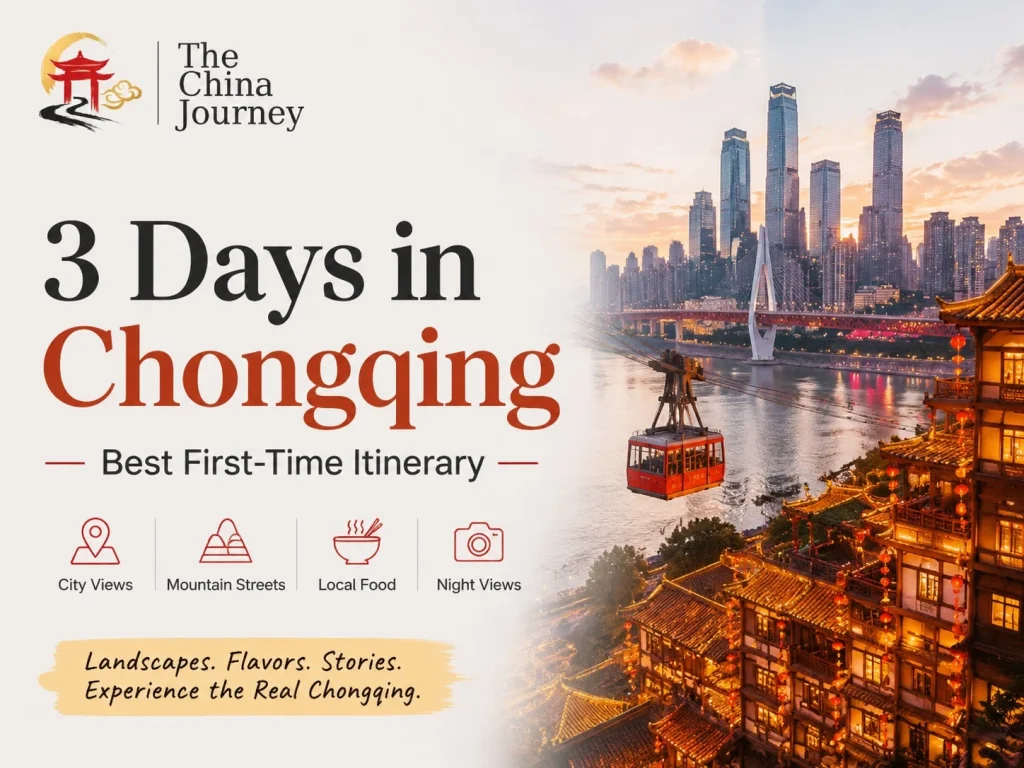
Plan 3 days in Chongqing with a practical first-time route covering city views, mountain streets, food, night views, costs, hotels, and key tips.
Table of Contents
Quick Answer: How Should You Spend 3 Days in Chongqing?
3 days in Chongqing is enough for a compact but rich first-time mountain-city experience. It is not a deep side-trip route, but it gives you enough time to move beyond simple check-ins and feel the city’s terrain, street life, food, and night views.
Best for: First-time visitors seeking a high-efficiency experience of Chongqing’s core highlights, including landmarks, night views, mountain-city streets, and local cuisine.
Main route logic: Day 1 builds the iconic landmarks and nightscape, Day 2 explores the city’s mountain terrain, streets, and local life, Day 3 allows a flexible choice of culture, nature, or food, with departure contingencies if needed.
What you can cover: Hongya Cave, Jiefangbei, Yangtze River Cableway, mountain-city streets, Liziba Light Rail, and core viewpoints.
What still needs trade-offs: Dazu Rock Carvings, Wulong, Wujiang Gallery, every creative park, and hidden neighborhood spaces are not realistic in the same 3-day city route.
Best travel pace: Compact and rhythmic; expect moderate uphill walking daily, with rest periods in the afternoon, especially on Day 3.
Main rule: Plan by area and elevation; reserve night-view time as an immovable highlight.
For a broader city overview, start with our Chongqing Travel Guide. For trip-length comparison, read our How Many Days in Chongqing guide.
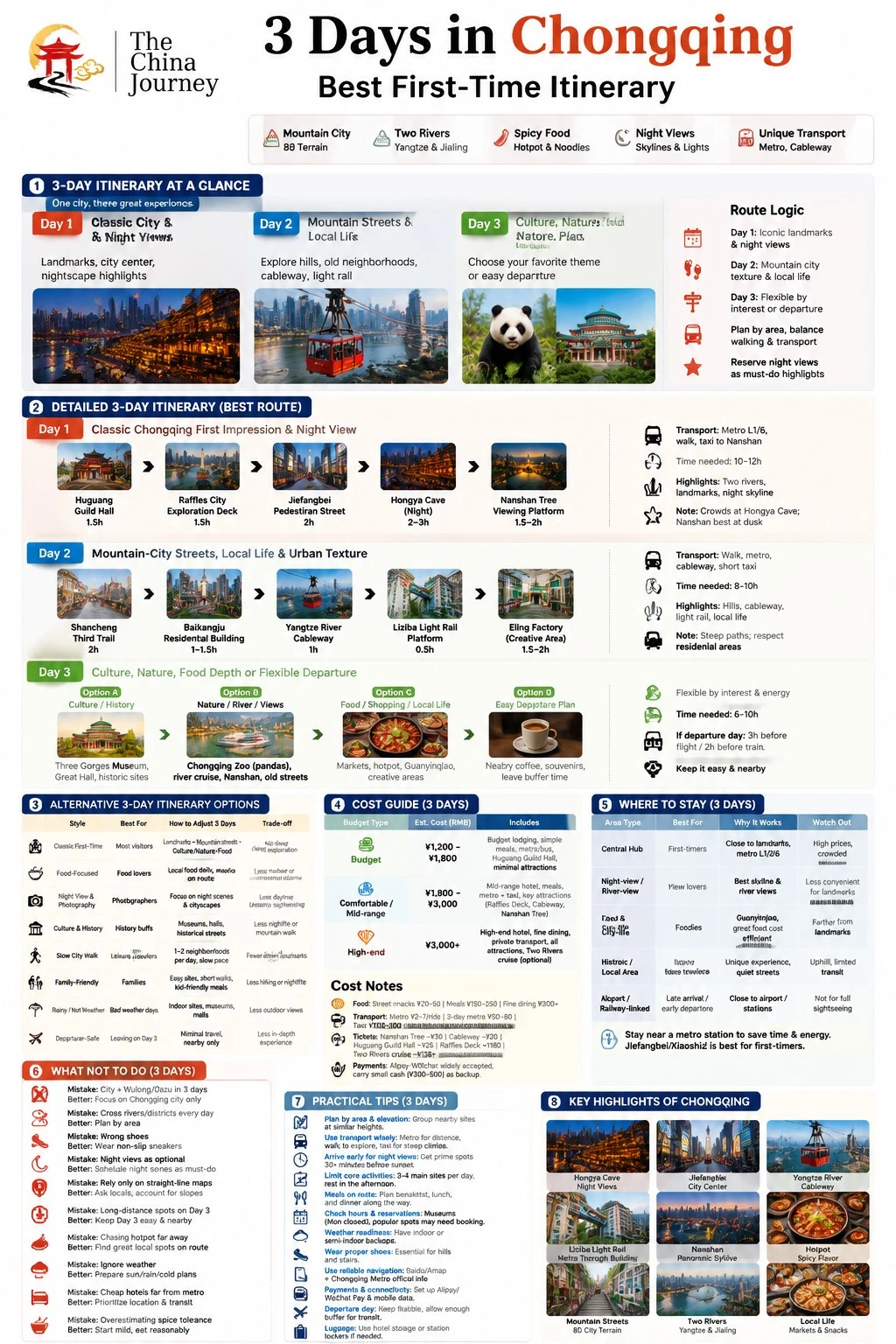
Detailed 3 day Chongqing travel infographic
Is 3 Days Enough for Chongqing?
Yes, 3 days is enough for Chongqing’s core city experience, but not enough for deep Chongqing or major side trips. You can cover the main landmarks, night views, mountain-city streets, distinctive transport, and local food without pretending to see everything.
Enough for: Key landmarks and viewpoints, experiencing the “mountain city / fog city / bridge city” character, sampling local hotpot and snacks, exploring 1–2 distinctive neighborhoods, and enjoying nightly city lights.
Limitations: Not enough time for Wulong, Dazu, Wujiang Gallery, or leisurely exploration of all creative districts, coffee shops, and hidden streets.
Best for: First-time visitors with limited time who want an efficient, high-value city experience. Suitable for multi-city travelers including Chongqing as a stopover.
Who may need more time: Photography enthusiasts, food explorers, history buffs, nature lovers, or anyone seeking a slow-paced, immersive journey should plan 4–5 days or more.
Practical judgment: Three days is a high-value length for Chongqing. It gives you more than a surface-level check-in, but only if you prioritize the city core and leave major side trips for another visit.
How to Plan a 3-Day Chongqing Itinerary
Changchun Chongqing Road
Planning Chongqing is different from planning a flat city. Terrain, elevation, and stairs matter as much as distance. A smart route saves energy by grouping nearby areas, using transit well, and avoiding repeated climbs.
Plan by area and elevation: Group nearby sites with similar elevation to minimize repeated climbs; e.g., Day 1: Yuzhong Peninsula low areas, Day 2: hillside trails and higher neighborhoods.
Balance walking and transport: Use metro for cross-district travel, walk to explore streets, and taxi short uphill segments when needed. Straight-line distances on maps are often misleading.
Protect night-view time: Reserve nightly city lights (e.g., Hongya Cave, Nanshan) as fixed highlights rather than post-dinner add-ons.
Put tiring routes earlier: Schedule physically demanding hikes or steps-heavy areas in the morning when energy is highest; afternoons can be lighter indoor or relaxed activities.
Check opening hours and reservations: Some museums close Mondays; cableways, observation decks, or popular restaurants may require advance booking, especially on holidays.
Keep meals on route: Plan breakfast, lunch, and dinner along the day’s path to avoid long detours.
Prepare weather backup: Summer heat, humidity, or rain may require indoor or semi-indoor alternatives.
Keep the final day safer: If departing, limit activities to nearby locations, and allow ample time for luggage retrieval, metro or taxi transfer, and airport/train station arrival.
3 Days in Chongqing Itinerary at a Glance
Use this quick route map before planning details. Each day has one main job: first impression, mountain-city texture, then a flexible final direction.
Day
Main Focus
Area Logic
Best For
Pace
Main Trade-Off
Day 1
Classic city first impression & night-view highlight
Full day in Yuzhong Peninsula core; landmarks → commercial center → nightscape
First-time visitors, quick impression seekers
Compact
Local life & hidden neighborhoods
Day 2
Mountain-city streets, local life & “8D” urban texture
Focus on hillside trails, historic buildings, cableways, and light-rail viewpoints
Explorers, photographers, urban-life enthusiasts
Moderate-to-high
Comfort sightseeing, easy walking
Day 3
Culture, nature, food depth, or flexible departure
Flexible by interest; culture, river views, or food
Travelers with specific interests or late departures
Flexible
Must choose one focus; cannot cover all
Best 3-Day Chongqing Itinerary for First-Time Visitors
Day 1: Classic Chongqing First Impression and Night View
Chongqing Shancheng Alley
Day 1 is the classic first-impression day: history and landmarks by day, then Chongqing’s strongest night views after dark. Keep the route focused so you have enough energy for the evening.
Best route logic: Begin at Huguang Guild Hall for immigration culture and dock history; head to Raffles City Exploration Deck for two-river and peninsula views; continue to Jiefangbei Pedestrian Street for lunch and commercial exposure; evening at Hongya Cave to see it light up; finish at Nanshan Tree Viewing Platform for full night panorama.
Suggested order: Huguang Guild Hall (1.5h) → Raffles City Deck (1.5h, incl. transit) → Jiefangbei (2h) → Hongya Cave (2–3h) → Nanshan Tree Platform (1.5–2h, incl. transit).
Transport: Metro Lines 1 & 6; walking connections; taxi to Nanshan (~30–40min).
Time needed: 10–12 hours; full but manageable.
Reservation / queue note: Holiday crowds at Hongya Cave; Nanshan ticketed, peak at dusk. Alternatives: Nanshan BBQ or Yihuali Night Park (require booking).
Best ending: A Nanshan viewpoint gives you the full Yuzhong Peninsula night panorama, with the rivers, bridges, and high-rises forming Chongqing’s most dramatic city view.
Watch out for: Crowds at Hongya Cave; long lines for Nanshan taxis at peak.
What not to add: Skip Ciqikou and Yangtze River Cableway; avoid overfilling Day 1 to protect night-view time.
Day 2: Mountain-City Streets, Local Life, and Deeper Urban Texture
Guanyinqiao night traffic with yellow taxis and large LED screen
Day 2 is where Chongqing feels different from most Chinese cities. The goal is not more landmarks, but the lived texture of slopes, stairs, residential towers, cableways, and light rail.
Best route logic: Start at Shancheng Third Trail/Zhongshan Fourth Road for uphill city experience; visit Baixiangju residential building for 1–1.5h; cross via Yangtze River Cableway (1h incl. queue); see Liziba Light Rail Platform (0.5h); end at Eling Factory for creative spaces, coffee, and possible dinner.
Transport: Walk + metro + short taxi segments as needed.
Time needed: 8–10 hours; high walking and elevation.
Good for: Photographers, urban explorers, architecture enthusiasts, visitors interested in local life.
Food logic: Lunch near Baixiangju (local noodles/dumplings), dinner at Eling Factory area.
Watch out for: Steep paths; Baixiangju is residential—stay quiet; cableway queues vary.
What to skip: Avoid distant spots like Ciqikou or additional heavy trails; maintain rest periods.
Day 3: Culture, Nature, Food Depth, or Flexible Departure Plan
Yangtze River Cable Car gliding over Chongqing skyline at sunset
Day 3 should stay flexible. Choose one direction based on your interest and energy, and keep it very conservative if you leave Chongqing that day.
Best route logic: Flexible third day; choose culture/history, nature/river views, food/shopping/local life, or light departure.
Suggested options:
Option A – Culture/History: Three Gorges Museum (2–3h, Mon closed); Great Hall of the People exterior; Zhongshan Fourth Road wartime sites.
Option B – Nature/River/Urban Landscape: Chongqing Zoo (pandas); daytime river cruise; Nanshan trails or Huangjueya Old Street.
Option C – Food/Shopping/Local Life: Sleep in; Xuetianwan Market; Guanyinqiao shopping; local hotpot; Jinshan Yiku creative area.
Option D – Easy Departure/Catch-Up: Nearby coffee; Jiefangbei souvenirs; Chen Mahua, hotpot base gifts; allow sufficient airport/train buffer.
If leaving Chongqing: Limit to nearby light activities; depart 3h before flight, 2h before high-speed train.
If staying overnight: Can explore any option A–C or enjoy evening entertainment, such as a performance or scenic bar.
Good flexible choices: Massage/foot spa, café breaks, bookstore visits, supermarket for souvenirs.
What to avoid: No long-distance or high-effort sites (e.g., Ciqikou, uphill trails, long queues).
Transport and luggage note: Use hotel luggage storage or station lockers if exploring post-checkout.
Watch out for: Check museum hours, Nanshan transit, and maintain phone battery for navigation.
Alternative 3-Day Chongqing Itinerary Options
You can adjust a 3-day Chongqing itinerary by interest, but every route has a trade-off. Choose one priority instead of trying to turn Day 3 into three different trips.
Itinerary Style
Best For
How to Adjust the 3 Days
What You Give Up
Classic first-time route
Most first-time visitors
Day 1: landmarks & night view; Day 2: mountain-city streets & local life; Day 3: culture/nature/food
Deep exploration of any single focus area
Food-focused route
Food lovers
Prioritize local cuisine daily; Day 1–3 meals embedded
Some natural or cultural sightseeing
Night-view & photography route
Photographers
Focus on night photography and cityscapes
Part of daytime sightseeing or relaxed walking
Culture & history route
History buffs
Day 3 focused on museums, halls, historical streets
Some mountain-city exploration, nightlife or food experiences
Slow city walk route
Leisurely travelers
Explore 1–2 neighborhoods per day at slow pace
Distant landmarks or night-view highlights
Family-friendly route
Families with kids/elderly
Easy landmarks, short walking, kid-friendly meals
Some hiking, steep trails, or nightlife experiences
Rainy-day / hot-weather route
Bad weather days
Indoor attractions, museums, malls
Outdoor viewpoints, night-scapes
Departure-safe route
Leaving on Day 3
Streamlined core route; minimal travel
Optional in-depth or extended sightseeing
How Much Does 3 Days in Chongqing Cost?
A 3-day Chongqing trip can be affordable or comfortable depending on hotel choice, food, taxis, and paid viewpoints. The estimates below exclude intercity travel. In Chongqing, heat, rain, hills, and fatigue can also increase taxi and drink costs.
Most travelers seeking balanced comfort and experience
High-end
¥3,000+
High-end hotel / river-view lodging (¥600+/night), fine dining (~¥300+/day), private transport, all desired attractions, optional Two Rivers cruise (~¥138+)
Travelers wanting convenience, premium experiences, and minimal stress
Short notes:
Accommodation: Costs vary by location; city center (Jiefangbei/Chaotianmen) is most convenient.
Transport: Metro 2–7 RMB per ride; 3-day metro use ~50–80 RMB; taxis 150–300 RMB; airport/railway transfer metro ~5–10 RMB, taxi 50–100 RMB.
Tickets and extras: Key attractions include Nanshan Tree (~30 RMB), Yangtze Cableway (~20 RMB), Huguang Guild Hall (~25 RMB), Raffles Deck (~180 RMB), Two Rivers cruise (~138+ RMB).
Weather / physical cost: Hot summer or cold, rainy days may increase taxis and drinks.
Payment note: Alipay/WeChat widely accepted; carry small cash (300–500 RMB) as backup.
Where to Stay for a 3-Day Chongqing Trip
For a 3-day Chongqing trip, location matters more than hotel style. A good base reduces uphill walking, cross-river transfers, and late-night taxi pressure after the night-view route.
Area Type
Best For
Why It Works for 3 Days
Watch Out For
Central sightseeing / transport hub
First-time visitors
Jiefangbei/Chaotianmen/Xiaoshizi; Metro Lines 1/2/6; walk to Hongya Cave, Raffles City, Bayi Food Street
High prices, crowded, older hotels may have noise
Night-view / river-view
Travelers seeking skyline & river vistas
Nanbin/Beibin Roads; excellent night photography
Less convenient for core city landmarks; may need taxis
Food & city-life
Food lovers, younger travelers
Guanyinqiao; Metro Lines 3/9; local restaurants & shopping; cost-efficient
Farther from traditional landmarks; extra metro rides needed
Historic / local neighborhood
Slow travelers, boutique stay
Chaotianmen old streets/Nanshan guesthouses; unique experience
Limited transit; uphill walking; not ideal with large luggage
Airport / railway-linked
Late arrival / early departure
Reduces commute to airport/train
Not suitable for full city sightseeing
Remote / special-purpose
Wulong/Dazu day trips
Only for extended multi-day trips
Far from city; unsuitable for standard 3-day itinerary
Short judgment: Prioritize hotels within 5–10 minutes of a metro station. Jiefangbei/Xiaoshizi is best for first-timers; Guanyinqiao is a solid alternative for budget or local-life immersion. For detailed neighborhood planning, use our Where to Stay in Chongqing guide.
What Not to Do With 3 Days in Chongqing
Mistake: Trying to cover city highlights plus Wulong/Dazu in 3 days. Better approach: Focus on Chongqing city only; reserve distant sites for separate trips.
Mistake: Crossing rivers or districts frequently each day. Better approach: Plan by area; e.g., Yuzhong Peninsula one day, Nanshan/South Bank another, Shapingba/Jiangbei on third day.
Mistake: Wearing leather shoes, heels, or non-slip-resistant footwear. Better approach: Wear comfortable, non-slip sneakers; expect ~20,000 steps/day with uphill walking.
Mistake: Treating night views (Hongya Cave, Nanshan) as optional. Better approach: Schedule night scenes as fixed highlights; arrive 30+ minutes before sunset.
Mistake: Relying solely on straight-line navigation apps in hilly streets. Better approach: Ask locals or shopkeepers; account for uphill/downhill differences.
Mistake: Scheduling long-distance spots (Ciqikou) on departure day. Better approach: Only plan nearby, low-effort activities; leave 3h (flight) / 2h (train) buffer.
Mistake: Cross-district trips for trending hotpot. Better approach: Use review apps to find highly-rated local spots within your route; saves time and energy.
Mistake: Underestimating summer heat or winter damp. Better approach: Summer: sunblock, hat, water; winter: windproof/waterproof layers; plan indoor alternatives.
Mistake: Staying in cheap hotels far from metro. Better approach: Prioritize proximity to metro and flat terrain over room size.
Mistake: Overestimating personal spice tolerance when ordering hotpot. Better approach: Start with mild or yuan-yang pot; pair with oil/sesame dip; portion reasonably.
Practical Tips for a 3-Day Chongqing Trip
Plan by area and focus: Group nearby attractions with similar elevation together to save energy and time. My rule is simple: tackle one area per day and avoid crisscrossing the city.
Combine transport wisely: Use metro for longer distances, walk for neighborhood exploration, and short taxi rides to bypass steep climbs or long detours.
Secure prime night-view spots: Arrive at Hongya Cave or Nanshan at least 30 minutes before sunset to capture the blue hour and avoid crowds.
Limit daily core activities: Keep the main itinerary to 3–4 major sites per day. Reserve afternoons for rest—coffee, foot massage, or short breaks.
Meals on route: Arrange breakfast, lunch, and dinner along your path to avoid wasted transit or time hunting for restaurants.
Check opening hours and reservations: Confirm via official WeChat accounts or map apps to prevent surprises, especially for museums or popular attractions.
Adapt to weather: Summer noon heat—plan indoor activities; rainy or foggy days—have half-indoor or indoor alternatives ready.
Wear proper shoes: Comfortable, non-slip footwear is essential for Chongqing’s steep streets and stairways.
Use reliable navigation: Rely on Baidu or Amap and check the Chongqing Metro official info rather than just straight-line GPS distance.
Set up payments and connectivity: Alipay or WeChat Pay should be ready, along with a working mobile data plan.
Leave departure day flexible: Keep it very relaxed if you must catch a flight or train; double-check travel time estimates.
Luggage management: Use hotel storage or station lockers for a smooth experience if you plan to explore after checkout.
For broader preparation advice, read our China Travel Tips.
Final Thoughts: Is 3 Days in Chongqing Worth It?
Three days in Chongqing is worth it for first-time visitors who want a compact but memorable mountain-city experience. It is not a deep Chongqing trip, but it gives you the city through sight, taste, and physical movement: light rail, Hongya Cave night views, hotpot, stairs, hills, and riverfront skylines.
The key is to plan by area, manage your energy, and accept trade-offs. Leave Wulong, Dazu, more hotpot hunting, and slow neighborhood travel for another trip. For most time-limited travelers, 3 days is the ideal opening length for Chongqing.
FAQ About Spending 3 Days in Chongqing
Is 3 days enough for Chongqing?
Yes. Three days is enough for first-time visitors to experience Chongqing’s core: landmarks, night views, mountain-city streets, cableways, hotpot, noodles, and one cultural direction. You will get a strong first impression of the city’s terrain and energy.
Is 3 days too short for Chongqing?
For city highlights, 3 days is not too short. For Wulong, Dazu, deeper food hunting, creative districts, or slow travel, it is short. Those plans need 4–5 days or more.
What is the best 3-day Chongqing itinerary for first-time visitors?
Day 1: city landmarks + night view; Day 2: mountain-city streets + local texture; Day 3: culture, nature, food, or flexible departure plan. This framework maximizes exposure while balancing effort and interest.
Should I include a side trip in 3 days?
Usually not. Wulong and Dazu require long travel time and can consume a full day. Add one only if you are willing to sacrifice most of the city experience.
Where should I stay for 3 days in Chongqing?
Jiefangbei or Xiaoshizi is ideal for first-timers: best metro and walking access. Guanyinqiao offers a more local vibe and better cost-effectiveness, but requires extra metro travel to reach central landmarks.
How much money do I need for 3 days in Chongqing?
Budget travelers may spend roughly ¥1,200–¥1,800, comfortable travelers ¥1,800–¥3,000, and high-end travelers ¥3,000+. The main variables are accommodation, hotpot meals, taxi use, viewpoints, cableways, and river-view extras.
I’m Anthony, the founder and editor of The China Journey.
I create practical, experience-based guides covering travel, food, and culture across China, with a focus on helping international travelers make clear planning decisions.
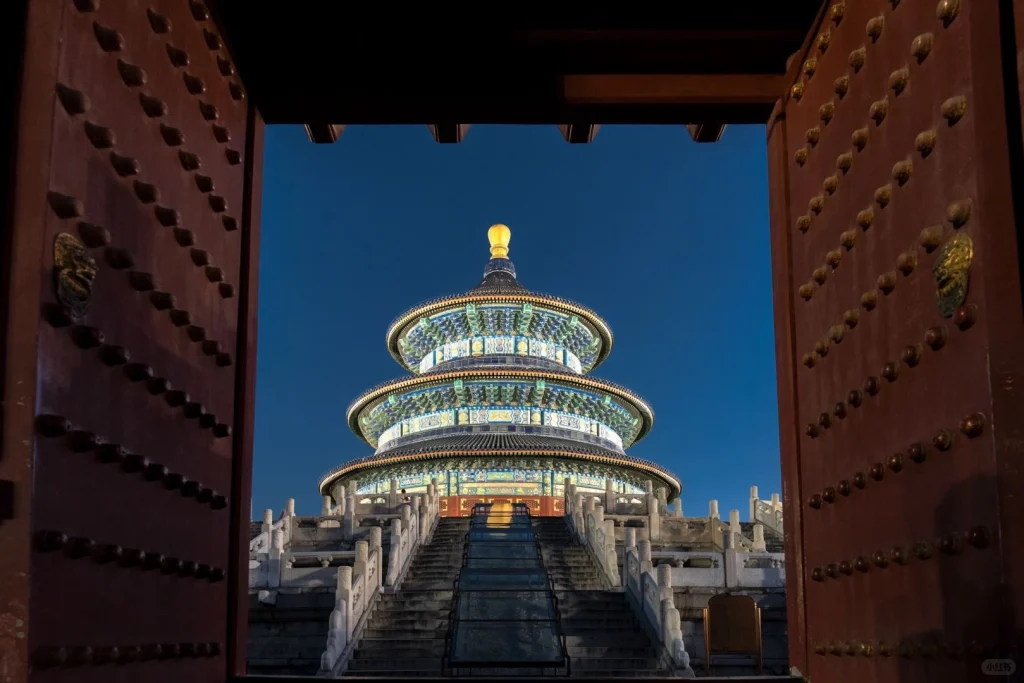
Temple of Heaven was built during the Ming Dynasty in 1420 as a place for emperors to offer sacrifices to heaven, pray for good harvests, and ask for rain.
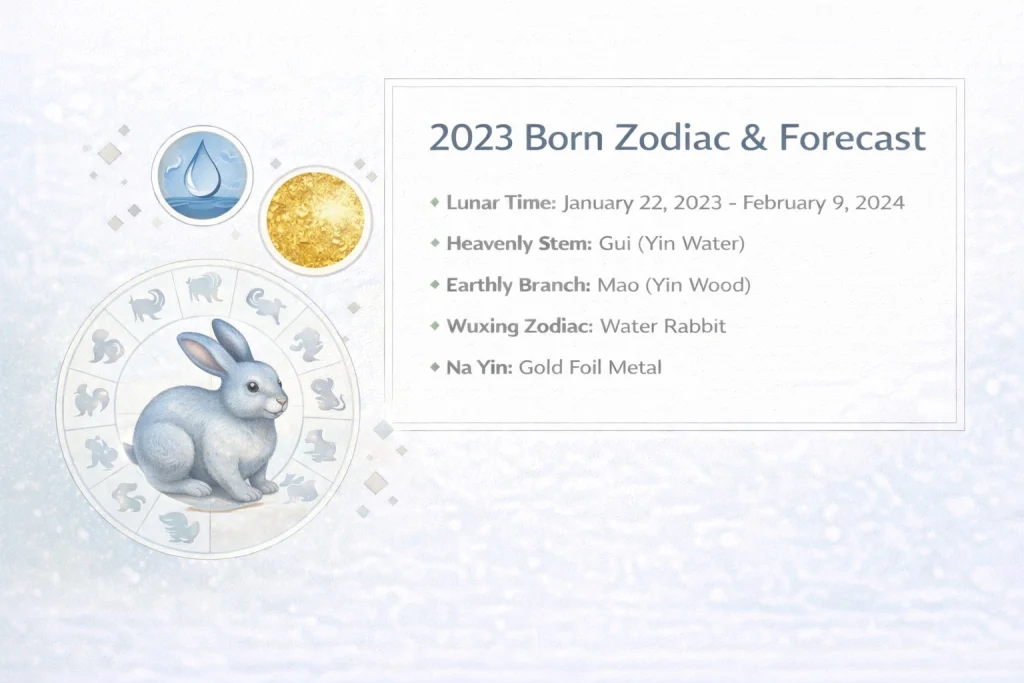
A gentle and structured 2026 forecast for children born in 2023, covering learning, relationships, health, lucky elements, and emotional development guidance.
A structured 2026 forecast for people born in 1960, covering career, wealth, relationships, health, lucky elements, and guidance for a stable, balanced year.
Plan Your China Trip with Our Experts
Share your travel ideas, and we’ll help you plan a smooth, personalized trip across China.
Plan Your China Trip with Our Experts
Share your travel ideas, and we’ll help you plan a smooth, personalized trip across China.
Work with Us as a Local Guide in China
We’re looking for experienced, part-time local guides to serve international travelers.
Requirements:
• Fluent in at least one foreign language • 3–5 years guiding international visitors • Able to operate in multiple regions in China • Competitive and reasonable pricing • Proven customer reviews or testimonials • Professional, reliable, and responsive • Flexible availability for custom trips
Just a quick heads-up — a helpful user named Volker let me know that some of the non-English content on this site may not be accurate.
This site is a one-person project I run part-time. I research and publish all the content myself, and the translations are currently done by machine (Google Translate). Balancing accuracy and accessibility across multiple languages is a real challenge.
If you spot any errors, I recommend switching to the English version using the button at the bottom left. I’ll continue working to improve the translations over time.
I truly appreciate your understanding. And if you have any suggestions, feel free to leave a comment — it means a lot to me.