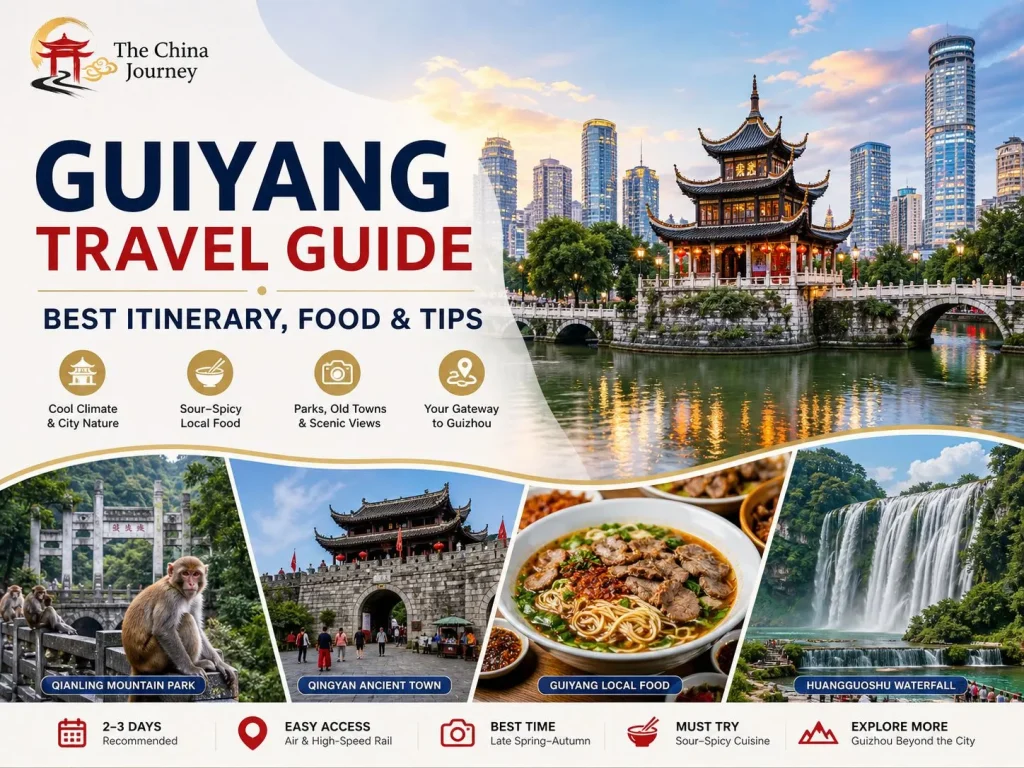
Plan your first Guiyang trip with top things to do, food, where to stay, best time to visit, and smart 2–3 day Guizhou gateway itineraries.
Quick Answer: Is Guiyang Worth Visiting for First-Time Travelers?
Yes — Guiyang is worth visiting for first-time travelers, but usually not as a top-priority standalone China city. Its strength is not one blockbuster landmark, but its role as a cool, food-strong, low-pressure gateway to Guizhou. It works best for travelers who want 2–3 days of local food, city parks, light sightseeing, and a smoother start to a wider Guizhou route, rather than nonstop headline attractions.
Worth visiting, but usually not a first-choice China city on its own
Strong as a Guizhou gateway, not as a landmark-driven destination
Best for food, city nature, and a slower urban pace
A good fit if you want a more grounded provincial-capital experience
Not ideal if you only want China’s biggest icons and must-see monuments
Works best as a 2–3 day stop, not a rushed same-day transit city
In This Guide
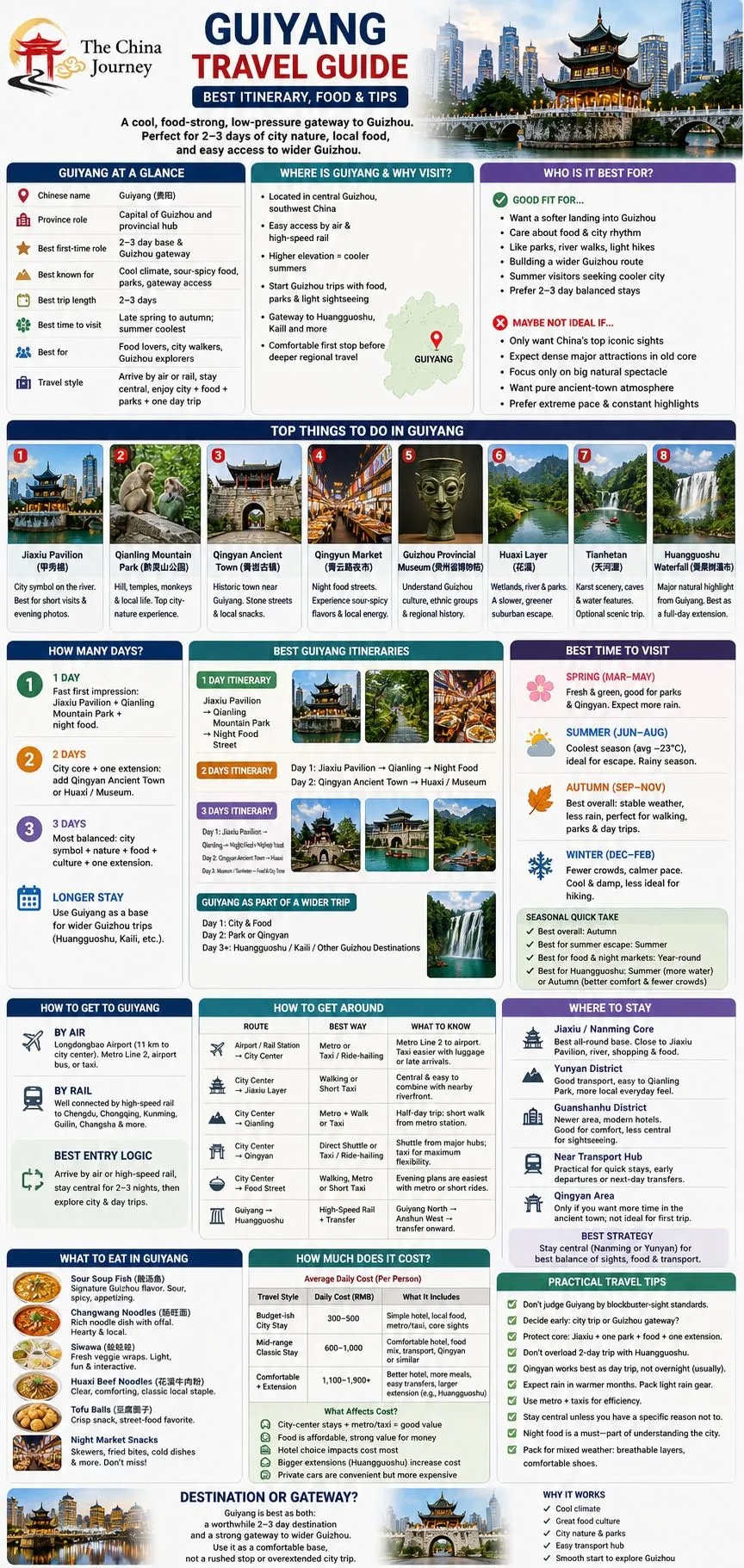
Guiyang travel guide infographic
Guiyang is best understood as a comfortable Guizhou gateway rather than a city built around one must-see landmark. Its real appeal comes from cool weather, strong food, easy city nature, and how smoothly it opens into the wider province.
This guide helps you decide whether Guiyang fits your trip, how many days to stay, what to prioritize first, and how to use it well either as a short destination or as the starting point for a broader Guizhou route.
Guiyang at a Glance
Field
Quick Take
Chinese name
Guiyang (贵阳)
Province role
Capital of Guizhou and the province’s main transport, cultural, and service hub
Best first-time role
A comfortable Guizhou entry city and a smart 2–3 day base, not a blockbuster landmark destination
Best known for
Cool summer climate, sour-spicy Guizhou food, city parks, and gateway access to wider Guizhou
Best trip length
2–3 days is the safest first-trip length
Best time to visit
Late spring to autumn; summer is coolest, autumn is most stable
Best for
Food-focused travelers, light city walkers, and travelers building a wider Guizhou route
Travel style
Arrive by air or rail, stay central, then combine city sights, food, parks, and one selective outer-day trip
Where Is Guiyang & Why Visit
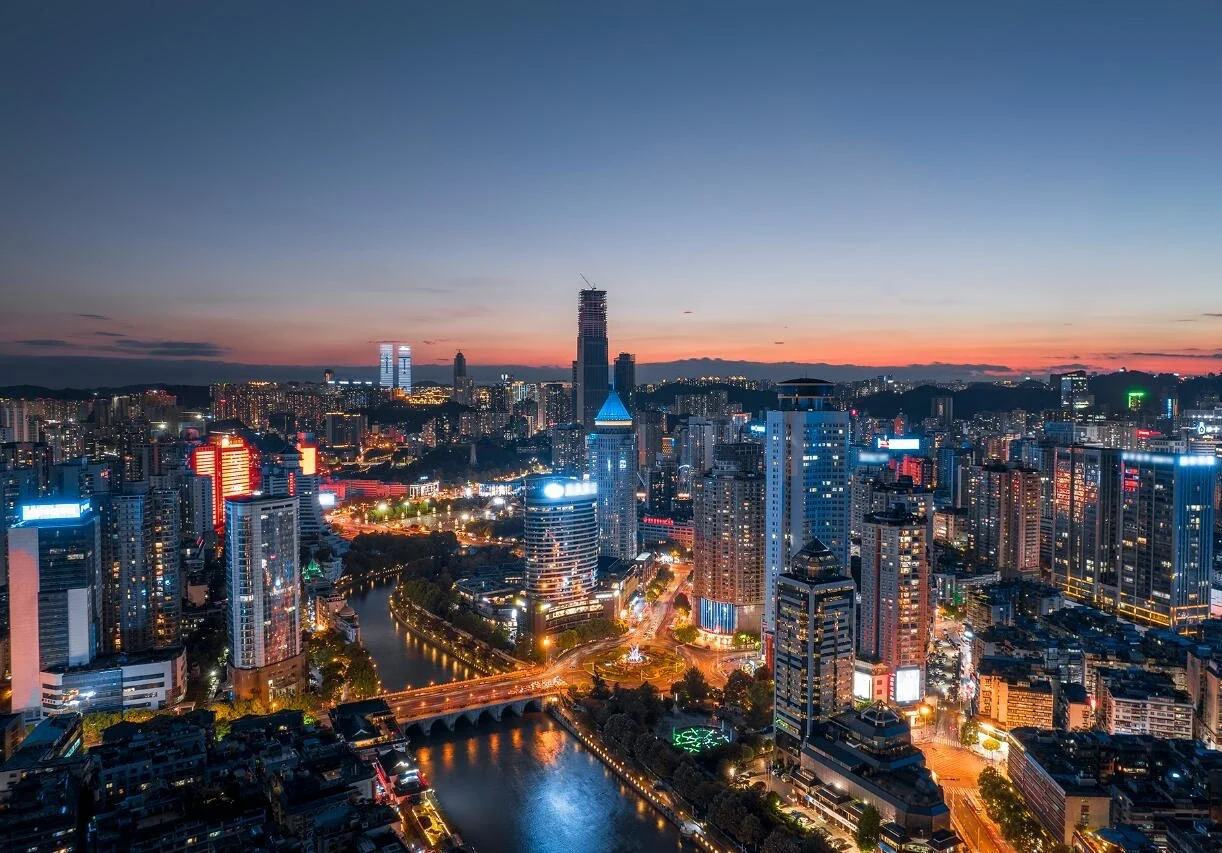
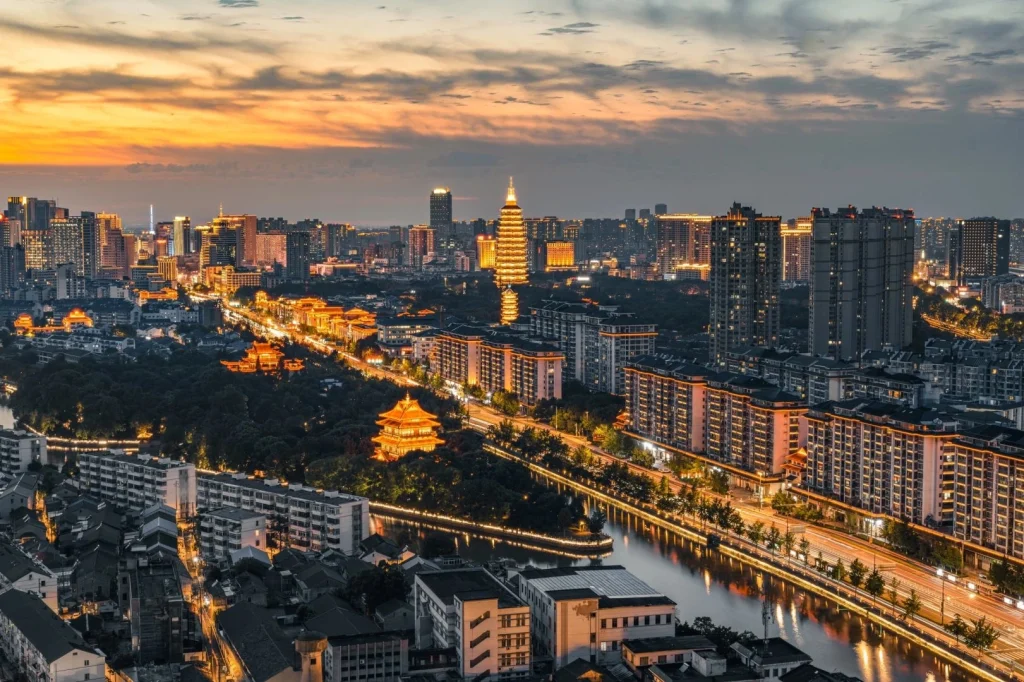
Guiyang Old Town Night Skyline
Guiyang sits in central Guizhou in southwest China, which makes it the province’s main entry point and route-planning anchor. For most travelers, its value is not just what is inside the city, but how well it works as a comfortable first stop before moving deeper into Guizhou.
It sits in the middle of Guizhou, so it links naturally to Huangguoshu, Kaili, and other classic provincial routes
It is one of the easiest places to enter Guizhou by air or high-speed rail, which lowers planning friction
Its higher elevation gives it a cooler summer profile than many major Chinese cities
It lets you start Guizhou with food, parks, and lighter city sightseeing before bigger waterfall or minority-village days
It works well as both a starting point and a rhythm-reset stop inside a longer Guizhou itinerary
It gives you a more manageable, lower-pressure southwest China city experience before moving into deeper regional travel
Who Guiyang Is Best For
Guiyang Financial District Sunset Skyline
Guiyang works best for travelers who do not need one world-famous landmark to justify a stop. Its value is usually clearest when you use it as a cooler, easier, food-strong city base that also opens the door to wider Guizhou. If your travel style likes a mix of city comfort, local flavor, and selective sightseeing, Guiyang is a strong fit.
Good fit for…
Travelers who want a softer landing before going deeper into Guizhou
People who care as much about food and city rhythm as about headline sights
Visitors who enjoy parks, river walks, light hills, and low-pressure city exploring
Travelers building a wider Guizhou route and needing a practical but worthwhile base
People visiting in summer who want a city that feels cooler and easier to handle
Travelers who prefer a 2–3 day city stay with a few clear priorities rather than nonstop landmark collecting
Maybe not ideal if…
You mainly want China’s most iconic first-trip sights and would rank them above all else
You expect a dense concentration of major attractions packed into a small historic core
Your focus is only on the biggest natural spectacle, not on the city that connects the route
You want a pure ancient-town atmosphere rather than a modern city with selected historic and natural layers
You prefer extreme pace, heavy checklist travel, and constant visual payoff every hour
Top Things to Do in Guiyang for First-Time Visitors
1. Visit Jiaxiu Pavilion (甲秀楼)
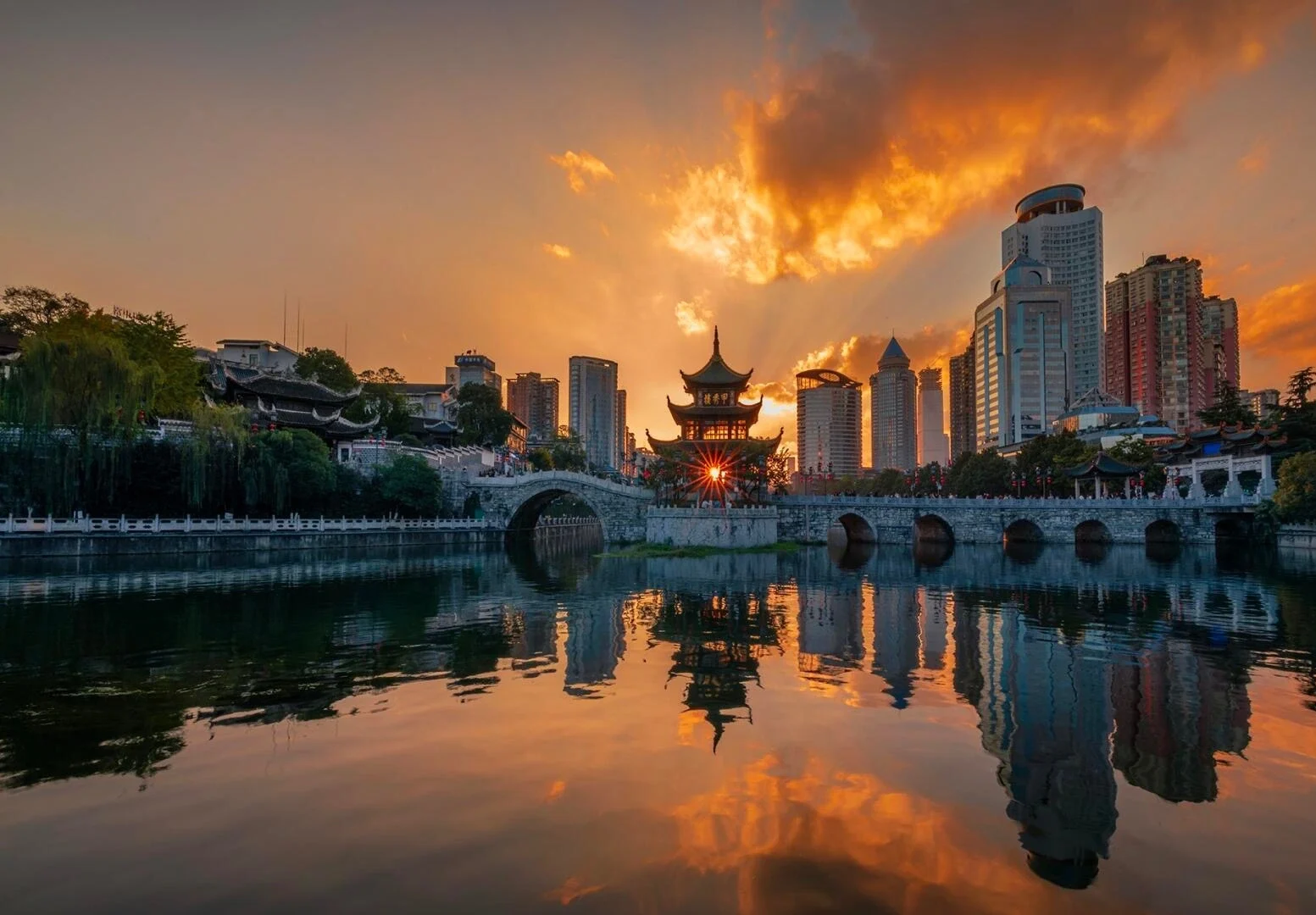
Jiaxiu Tower Sunset Reflection Guiyang
Jiaxiu Pavilion is worth visiting because it gives you the clearest visual symbol of Guiyang without requiring much time. It suits almost all first-time visitors, especially those who want a quick, low-effort city marker before moving into deeper layers. In a Guiyang route, this is a symbolic stop rather than the main experience core. The right trade-off is to treat it as a short riverside walk or evening photo stop, not as a half-day attraction that takes time away from stronger layers like food, Qianling Mountain Park, or Qingyan.
2. Go to Qianling Mountain Park (黔灵山公园)
Qianling Mountain Park Entrance Gate
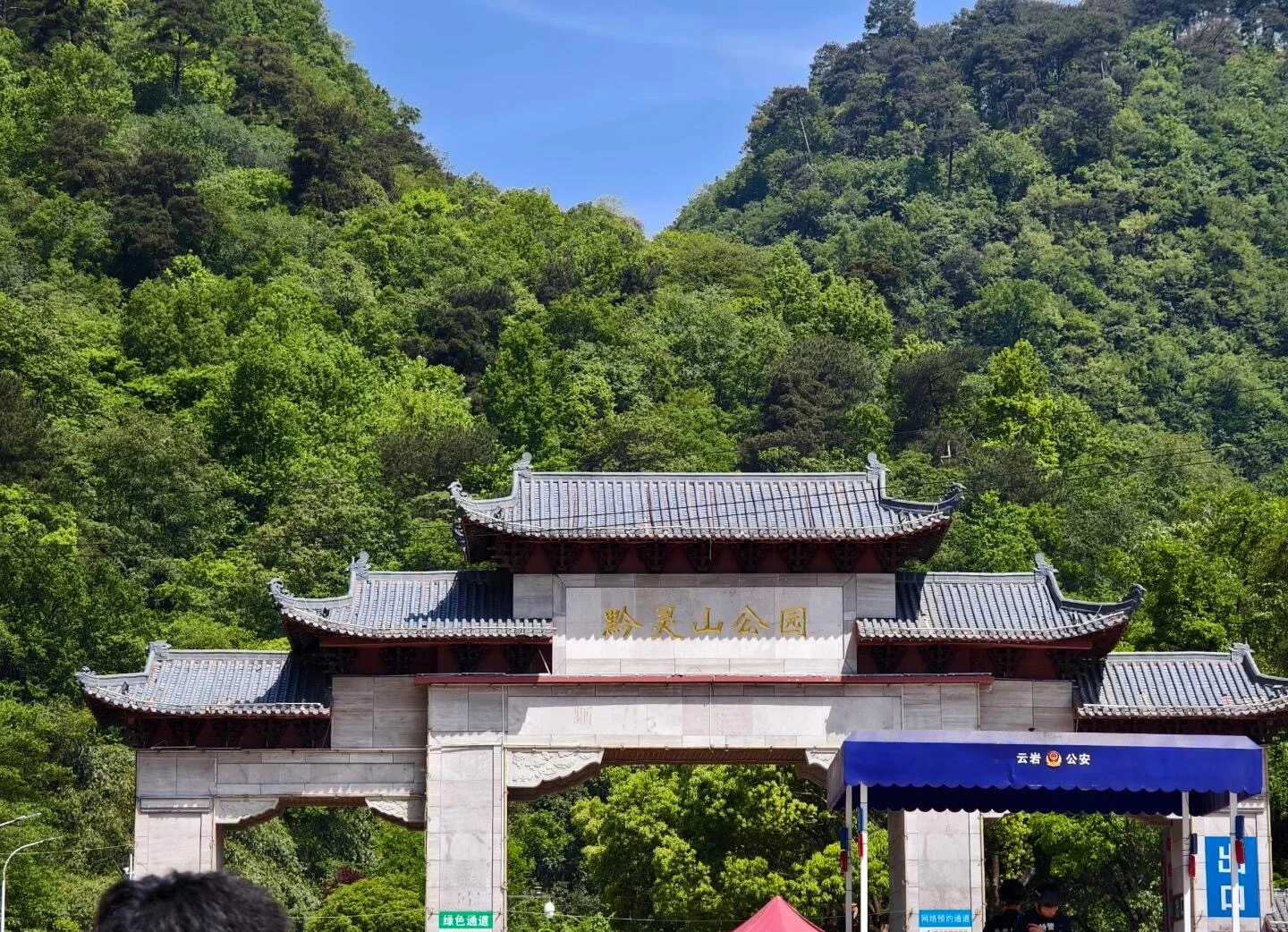
Qianling Mountain Park is worth visiting because it shows Guiyang’s strongest city-nature layer: hill walking, temple atmosphere, monkeys, and local park life in one place. It suits visitors who like light hiking, green space, and seeing how locals use the city. In a Guiyang route, this is one of the core half-day experiences and usually ranks above other urban-nature stops. If you are choosing only one city park or hill layer on a short trip, this should usually be the one you keep.
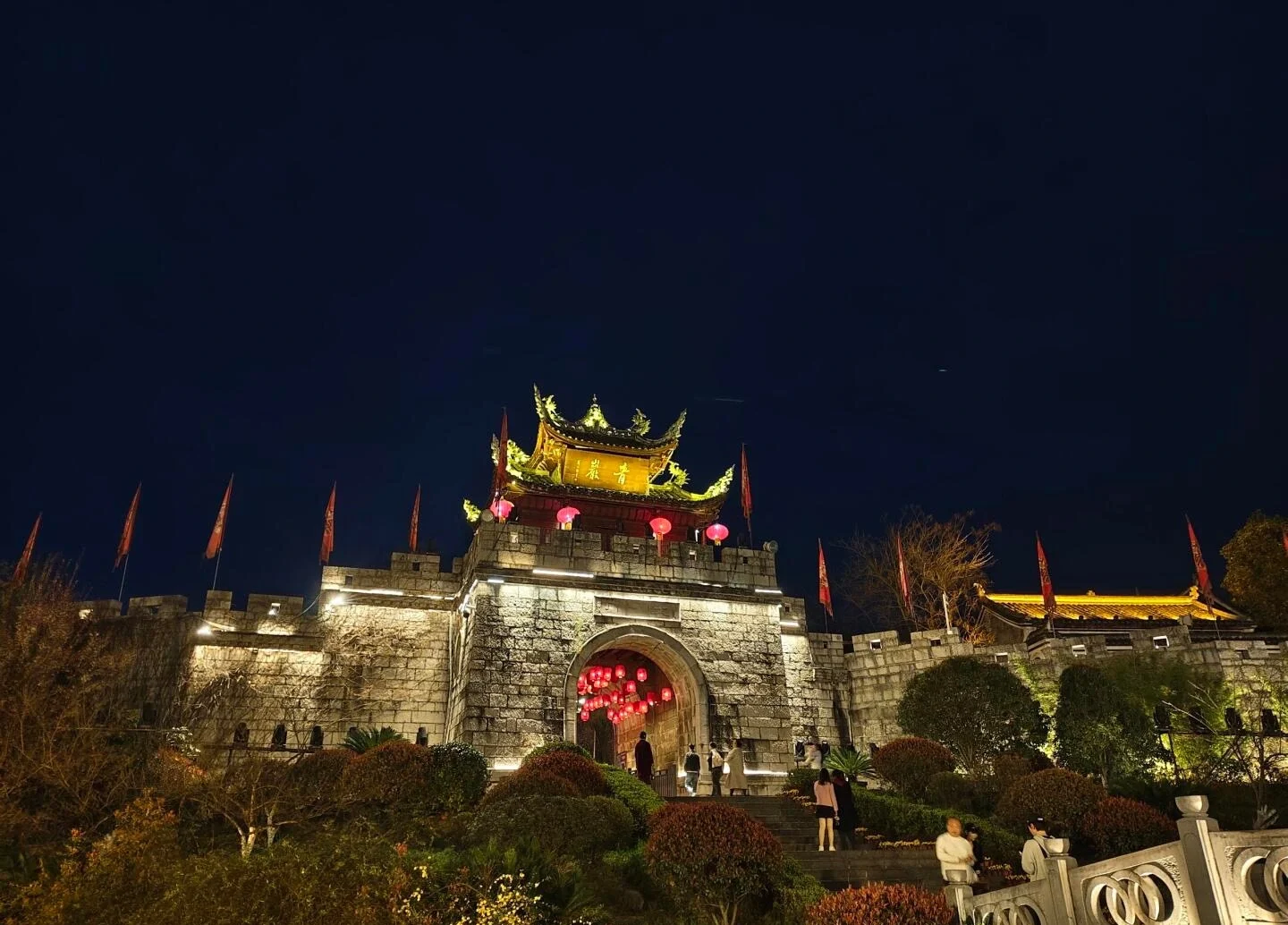
3. Explore Qingyan Ancient Town (青岩古镇)
Qingyan Ancient Town City Gate
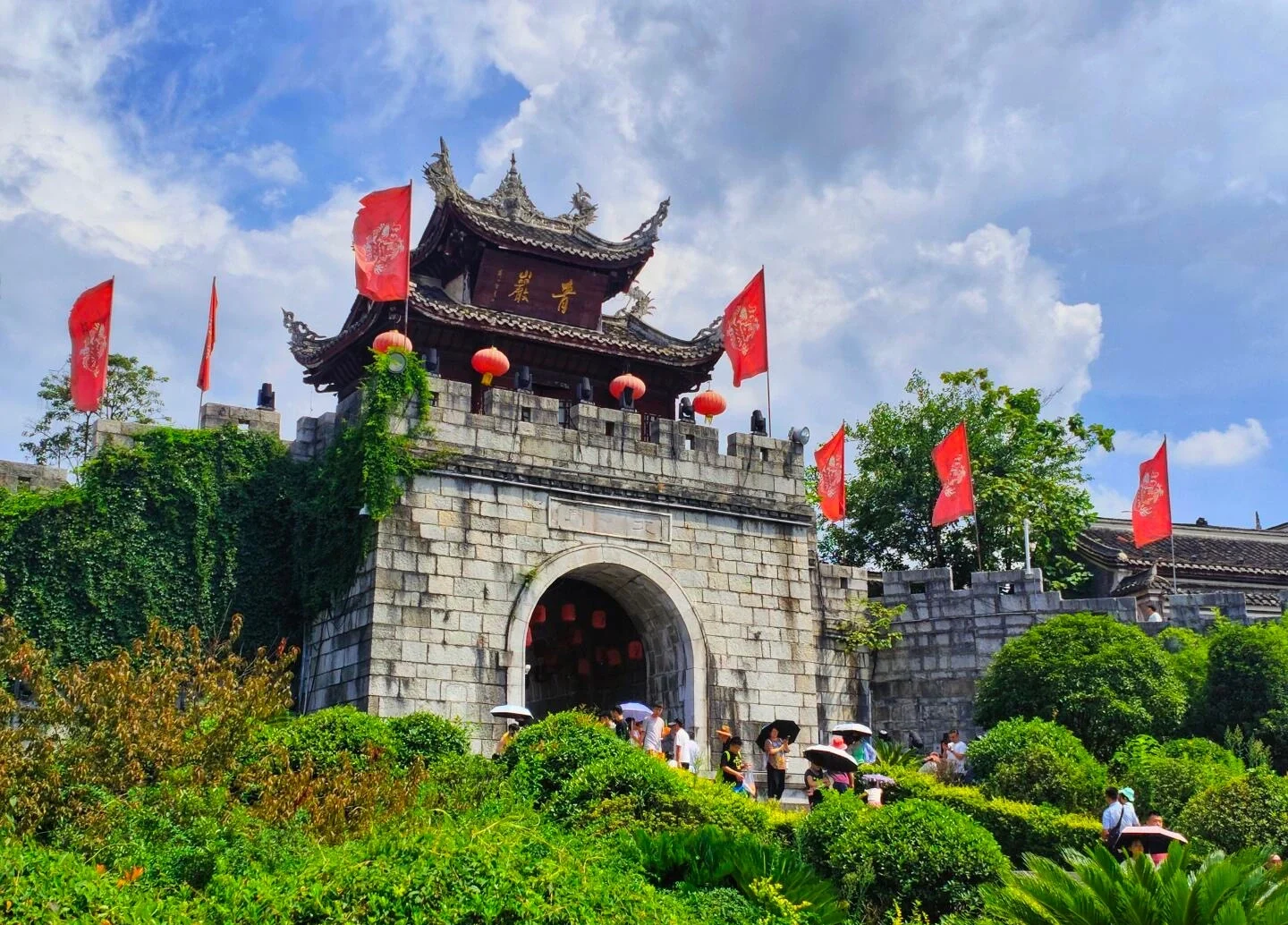
Qingyan Ancient Town is worth visiting because it adds the strongest historic-town layer near Guiyang and gives the trip more architectural contrast than the city center alone. It suits travelers who want stone streets, old-town atmosphere, and local snacks without committing to a much longer Guizhou detour. In a Guiyang route, this is the main outer-city extension rather than a city-core stop. The trade-off is time: it works well on a 2–3 day trip, but if your stay is very short, protecting the city core and food layer may be smarter.
4. Eat through the Qingyun Market (青云路夜市) / night-food layer
Qingyun Market Street Art District
This is worth doing because Guiyang makes more sense through food than through monuments alone. The night-food layer gives you the city’s sour-spicy logic, evening energy, and one of its clearest forms of local life. It suits almost every traveler, especially food-first visitors and people who want the city to feel lived-in rather than staged. In a Guiyang route, this is an essential daily-life layer, not a filler extra. The best trade-off is to protect one strong evening food block instead of overloading the day with weaker sightseeing.
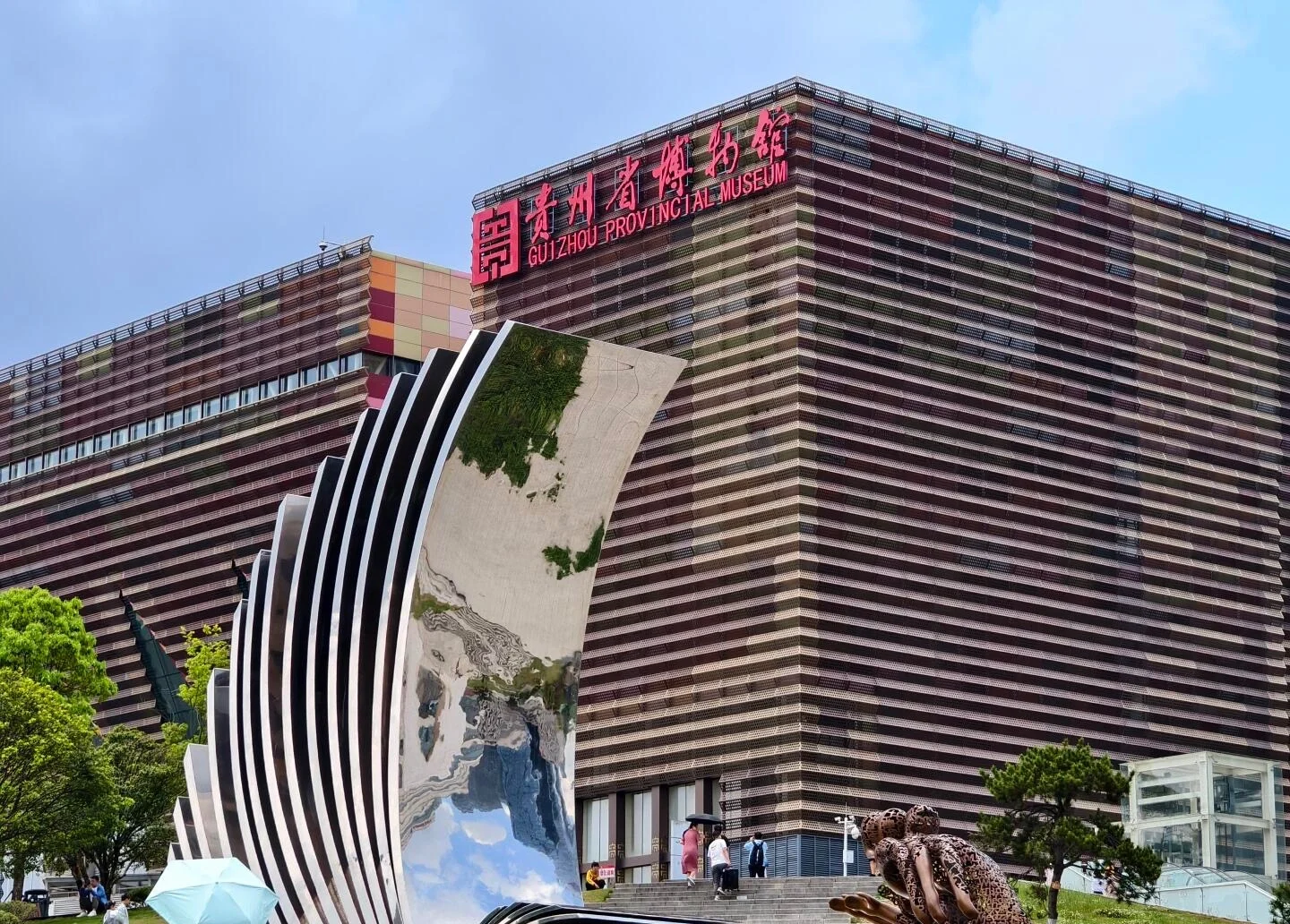
5. Visit Guizhou Provincial Museum (贵州省博物馆)
Guizhou Provincial Museum Interior Exhibition
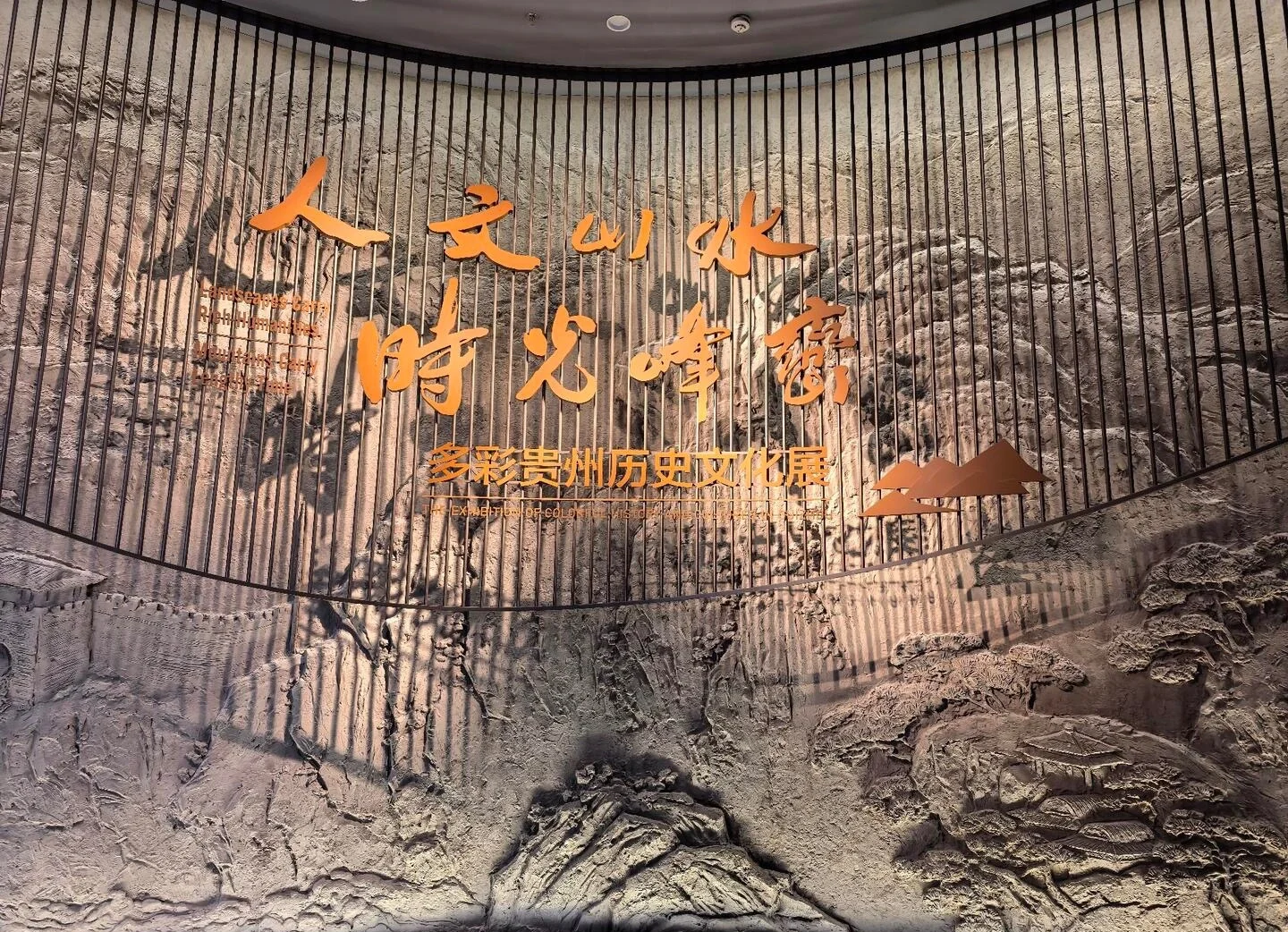
The museum is worth visiting because it helps you understand the wider province that Guiyang is introducing you to. It adds ethnic, historical, and regional context that makes later Guizhou travel feel easier to read, especially if you are continuing to villages, waterfalls, or minority areas. It suits travelers who value background and structure, not just movement between sights. In a Guiyang route, this is a context layer rather than a core emotional highlight. Keep it if you want orientation; cut it first if your trip is short and you would rather spend that time on food, Qingyan, or Qianling.
6. Add the Huaxi layer (花溪)
Huaxi Yelang Valley Stone
The Huaxi layer is worth doing because it gives Guiyang a softer, greener, and more leisurely side through wetland, river, and suburban park space. It suits travelers who prefer slower movement, easier walking, and a calmer extension after the busier central layers. In a Guiyang route, this is a secondary green-space add-on rather than a first-priority must-see. The trade-off is clear: on a short first trip, Qianling usually matters more; on a 3-day trip, Huaxi starts to make much better sense.
7. Consider Tianhetan (天河潭)
Tianhetan Scenic Area River Boats
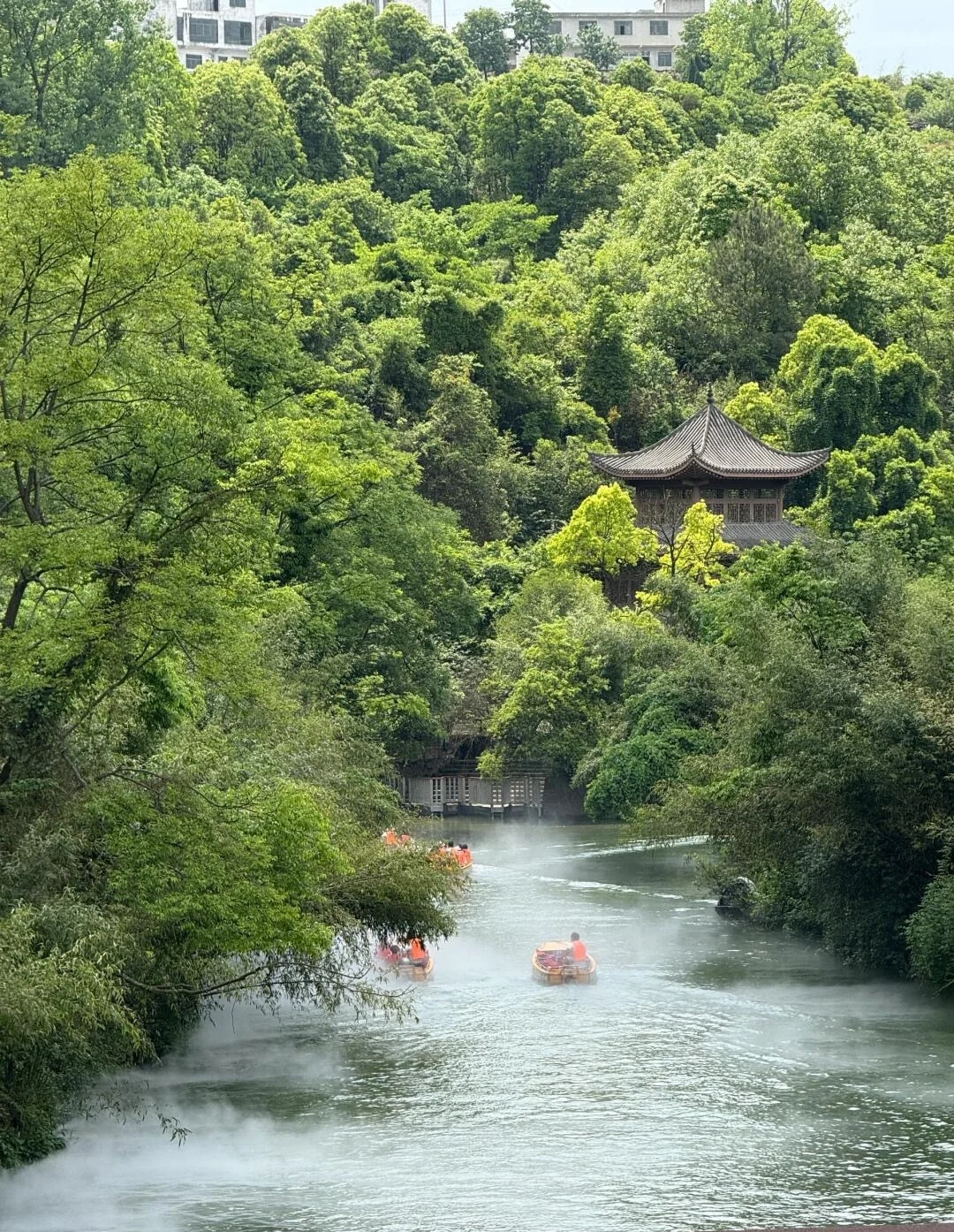
Tianhetan is worth visiting because it gives you a compact taste of Guizhou-style karst scenery, caves, and water features without needing a full province-wide excursion. It suits travelers who want some landscape variety but do not have the time or energy for a larger day trip deeper into Guizhou. In a Guiyang route, this is an optional scenic extension, not part of the default first-trip core. It can be rewarding, but it usually ranks below Jiaxiu, Qianling, Qingyan, and the food layer for first-time visitors with only 2–3 days.
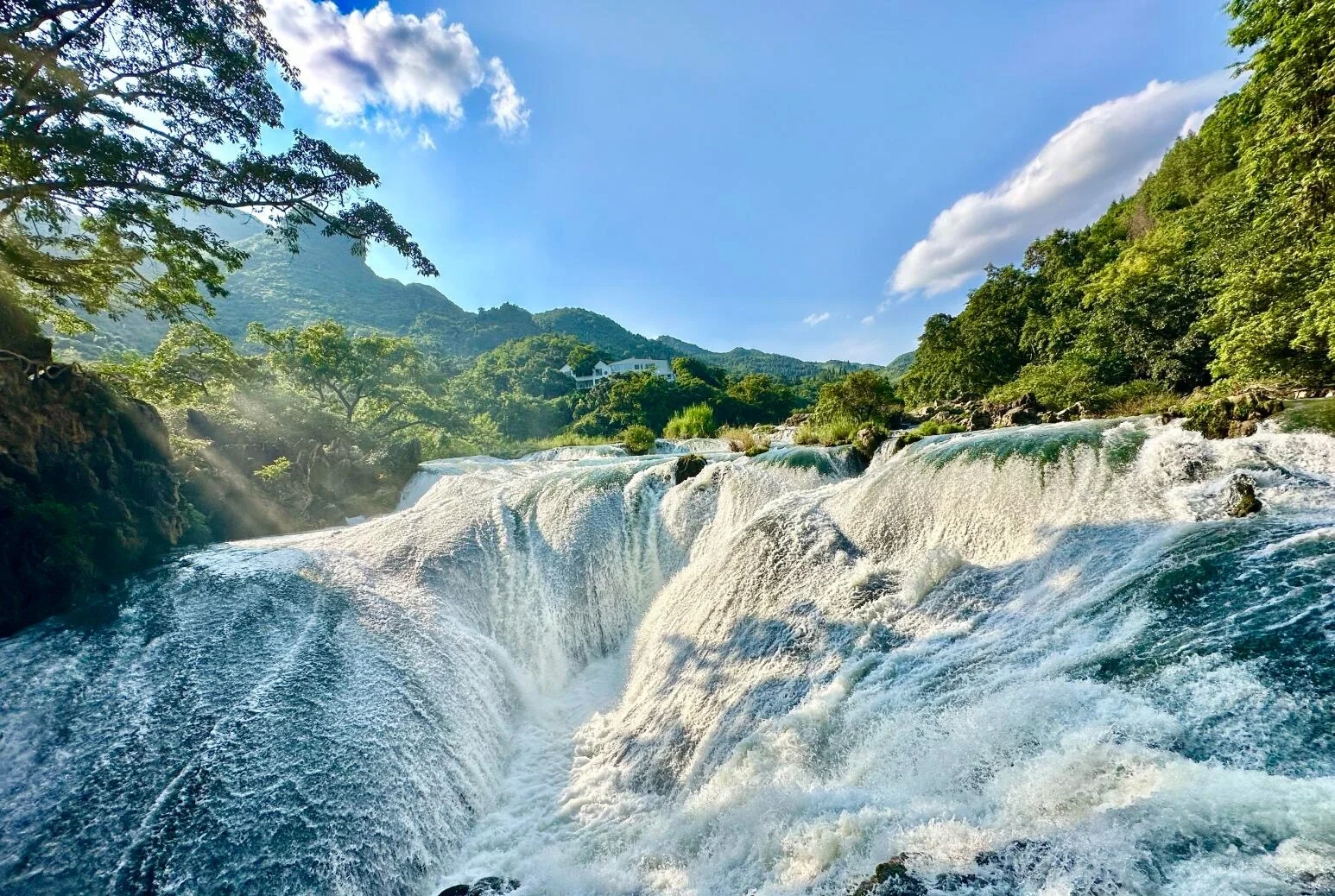
8. Use Huangguoshu Waterfall (黄果树瀑布) as a major extension from Guiyang
Huangguoshu Waterfall Scenic View
Huangguoshu Waterfall is worth doing because it is one of Guizhou’s biggest natural highlights and the clearest reason many travelers expand a Guiyang-based trip into a wider provincial route. It suits travelers who want a genuine large-scale natural spectacle and are willing to dedicate a full day to it. In a Guiyang route, this is not a city attraction at all but a major extension from the city. The trade-off is energy and time: do not squeeze it casually into a short city stay. It works best when Guiyang is acting as your base or gateway, not when you are trying to keep the trip city-focused.
How Many Days Do You Need in Guiyang?
Jiaxiu Pavilion Night View Guiyang
Guiyang works best when you treat it as a selective city stay, not a place to “finish” completely. For most first-time visitors, the real question is not how many sights you can fit in, but how much city layer, food layer, and Guizhou-extension value you want from the stop.
1 day: Enough for a fast first impression only. You can cover Jiaxiu Pavilion, one stronger city layer such as Qianling Mountain Park, and one evening food block. It works, but only as a compressed city sample.
2 days: This is the safer lower limit. You can combine the city core with one stronger outer-city layer such as Qingyan Ancient Town, while still leaving room for food and a more relaxed pace.
3 days: This is the most mature first-trip answer. You can cover the city symbol, nature, food, one culture layer, and one extension without making Guiyang feel rushed.
Longer stays: Longer stays usually make the most sense when Guiyang becomes a base for wider Guizhou travel rather than a deeper city-only trip. This is when Huangguoshu, minority-village routes, or other provincial extensions become natural.
For most first-time visitors, 2–3 days is the strongest range: long enough to understand Guiyang, short enough to keep the wider Guizhou route moving well.
If you are still shaping a broader country route, it also helps to think through How Long to Spend in China before locking in your Guizhou segment.
Best Guiyang Itineraries for First-Time Visitors
1 Day in Guiyang
Qianling Mountain Park Monkeys
Who it’s for
Travelers with very limited time who still want a usable first impression of Guiyang rather than treating it as a pure transit stop.
Route logic
Keep the structure tight and city-focused. Protect one symbolic stop, one stronger lived-in layer, and one food block. Do not force major outer-city extensions.
Main stops
Jiaxiu Pavilion → Qianling Mountain Park → evening food street or Qingyun Market
Why this itinerary works
One day is not enough to understand everything Guiyang can do, but it is enough to catch its basic logic. Jiaxiu gives you the city symbol, Qianling Mountain Park shows the mountain-in-the-city character, and the night-food layer delivers one of Guiyang’s most important strengths. This version works because it avoids overreaching. Instead of trying to fit in Qingyan Ancient Town or a waterfall extension, it keeps the experience compact, readable, and realistic for a first-time visitor.
2 Days in Guiyang
Qingyan Ancient Town Night Gate
Who it’s for
Most first-time visitors who want a balanced short stay and do not want the city to feel like a rushed stop between trains or scenic areas.
Route logic
Day 1 should cover the city core and food. Day 2 should add the strongest outer-city or culture layer without overloading the schedule.
Main stops
Day 1: Jiaxiu Pavilion → Qianling Mountain Park → Qingyun Market or another night-food layer
Day 2: Qingyan Ancient Town → optional Huaxi layer or Guizhou Provincial Museum
Why this itinerary works
Two days is the minimum stable version of Guiyang. You get the city symbol, the city-nature layer, the food identity, and one meaningful extension beyond the center. That combination is enough to make Guiyang feel like a destination, not just a base. It also gives you flexibility: culture-focused travelers can add the museum, while slower travelers can lean into Huaxi instead. The structure works because it respects Guiyang’s real strengths rather than forcing too many secondary stops into a short stay.
3 Days in Guiyang
Guizhou Provincial Museum Exterior Design
Who it’s for
First-time visitors who want the most complete and best-paced city experience before deciding whether to continue deeper into Guizhou.
Route logic
Build around four layers: city symbol, city nature, food, and one or two selective extensions. This gives Guiyang enough room to feel coherent rather than fragmented.
Main stops
Day 1: Jiaxiu Pavilion → Qianling Mountain Park → night-food layer
Day 2: Qingyan Ancient Town → Huaxi layer
Day 3: Guizhou Provincial Museum or Tianhetan → another focused food block or slower city time
Why this itinerary works
Three days is usually the best first-time city structure because it gives Guiyang enough breathing space. You can cover the essential city layers without turning the trip into a checklist, and you still have room to choose your emphasis. If you want more culture, keep the museum. If you want more landscape, choose Tianhetan. If you care most about atmosphere and food, use the final day more lightly. This is the version where Guiyang’s role becomes clearest: not a blockbuster city, but a comfortable, flavorful, well-connected provincial capital with real travel value.
Guiyang as Part of a Wider Guizhou Trip
Huangguoshu Waterfall in Guizhou
Who it’s for
Travelers using Guiyang as the entry point or rhythm-setting base for a larger Guizhou journey that may include Huangguoshu Waterfall, minority villages, or other regional highlights.
Route logic
Use Guiyang for orientation, food, and recovery, then let the bigger natural and cultural spectacles happen outside the city. The city should support the wider route, not compete with it.
Main stops
Day 1: Jiaxiu Pavilion + food layer
Day 2: Qianling Mountain Park or Qingyan Ancient Town
Day 3 onward: Huangguoshu Waterfall, Kaili / Xijiang, or other Guizhou extensions
Why this itinerary works
This is often Guiyang’s strongest role. The city gives you a comfortable landing point, easier logistics, and a softer start before the heavier scenic or cultural parts of Guizhou. It also works well in reverse, as a place to slow down after longer trips into the province. Instead of asking Guiyang to carry the full weight of the journey, this structure lets it do what it does best: provide access, food, recovery time, and a manageable urban layer inside a much bigger Guizhou trip.
If Guiyang is only one stop in a bigger route, it also helps to map the wider structure first with How to Plan a China Trip.
Best Time to Visit Guiyang
Guiyang works in every season, but not in the same way. For most first-time visitors, autumn is the safest overall choice, while summer is the most distinctive because of the city’s well-known coolness compared with many hotter Chinese cities. Rain matters here, especially from late spring into summer, so season directly affects walking comfort. For a wider national view, see our Best Time to Visit China guide.
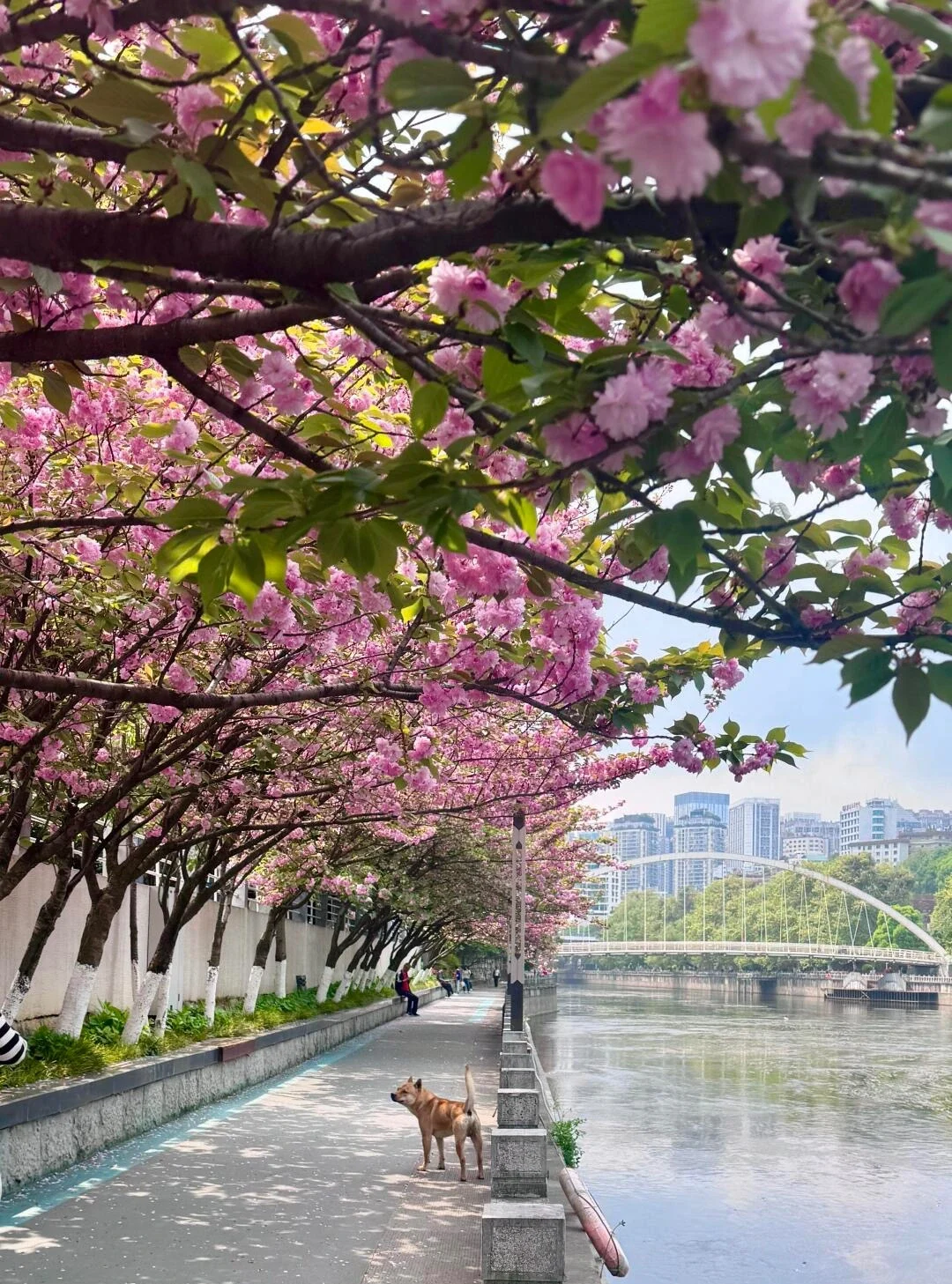
Spring
Guiyang Riverside Park Cherry Blossoms
Spring is a good season for city walking, park time, and a Qingyan outing, but you need to expect damp air and regular rain. Guiyang usually feels fresh rather than hot, and Qianling Mountain Park and other green areas look especially lively at this time. The tradeoff is that old-town walking and hill paths can feel slick after rain, so it is better for travelers who do not mind flexible pacing.
Summer
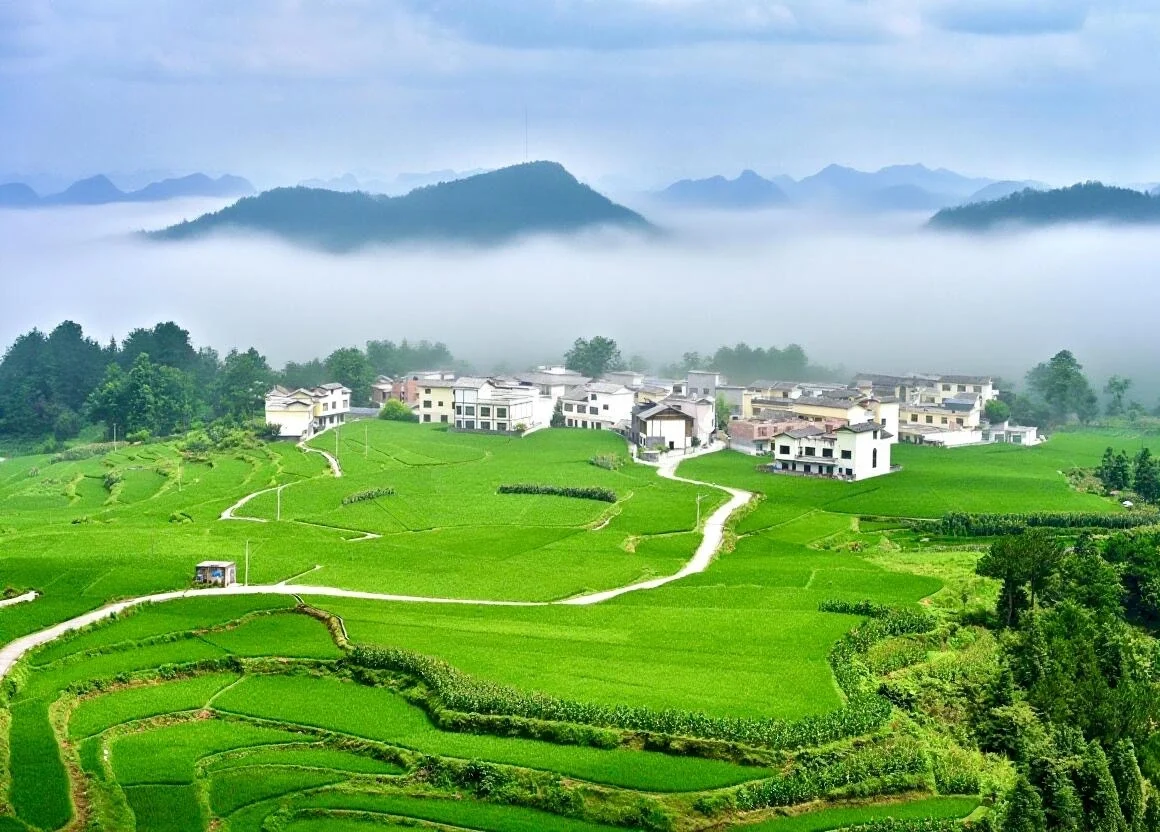
Huaxi Shimen Terraced Fields Summer View
Summer is when Guiyang stands out most clearly. Over the past decade, the city’s average summer temperature has been about 23°C, and days above 30°C are relatively limited, which is why it is marketed so strongly as a summer-resort city. This is great for city walking by Chinese summer standards, and night markets are especially comfortable in the evening. The main downside is the rainy season: rainfall is frequent, often at night, and daytime plans still need weather flexibility. Summer is also the strongest season for Huangguoshu, because waterfall flow is fuller, but this comes with more visitors and more weather uncertainty.
Autumn
Shili River Wetland Autumn Forest
Autumn is usually the best overall season for first-time visitors. It is easier for city walking, park and hill walking, and day trips like Qingyan, because the weather is generally steadier and less wet than late spring or summer. Food and night-market exploration also feel easier when you are not working around rain or humidity. If you want the most balanced version of Guiyang, this is usually it.
Winter
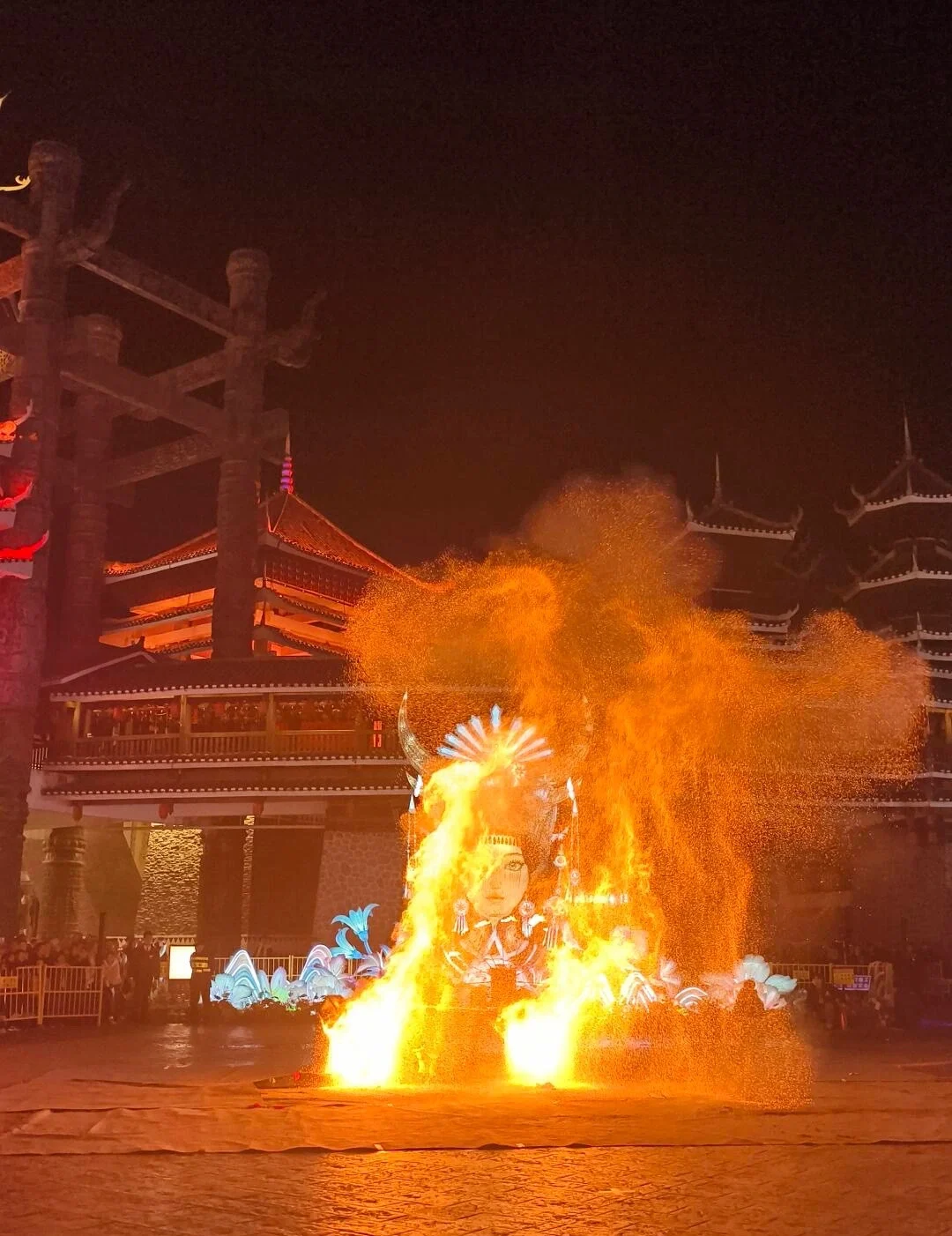
Guizhou City Spring Festival Fair Night
Winter is workable, but it is not the city’s signature season. The upside is fewer crowds and a calmer pace for food-focused travel and shorter city walks. The downside is that Guiyang’s winter can feel damp and chilly, so long outdoor sessions in parks or hills are less appealing than in autumn. Huangguoshu can still be visited, but winter is usually more about lower crowds than best scenery.
Seasonal quick take
Best overall: autumn for the most stable balance of walking comfort, lighter rain, and flexible sightseeing.
Best for summer escape: summer, because Guiyang stays notably cooler than many major Chinese cities.
Best for city walking and Qingyan: autumn first, spring second if you can accept more rain.
Best for parks and hill walking: spring and autumn are safest; summer works, but rain can disrupt plans.
Best for food and night markets: year-round, though summer evenings and autumn nights are especially comfortable.
Best for Huangguoshu from Guiyang: summer for fuller water flow, autumn for a better comfort-and-crowd balance.
How to Get to Guiyang
Guiyang is the capital of Guizhou and the province’s main transport hub, so reaching it is usually straightforward. For most first-time visitors, the real question is not whether Guiyang is easy to enter, but whether you want to use it only as an arrival point or as a 2–3 day city base before moving deeper into Guizhou. For a broader national overview, see our China Transportation Guide.
By air
Guiyang Longdongbao Airport Sunset
Guiyang Longdongbao International Airport is about 11 kilometers from the city center. You can reach downtown by Metro Line 2, airport shuttle bus, or taxi. In practice, metro is the simplest budget option, while a taxi is easier if you arrive late, carry luggage, or want a direct hotel drop-off.
By rail
Guiyang North Railway Station Entrance
Guiyang is well connected by high-speed rail and works especially well for travelers already moving through Southwest China. High-speed links connect Guiyang with cities such as Chengdu, Chongqing, Kunming, Guilin, and Changsha, and Guizhou’s own day-trip and regional routes also depend heavily on Guiyang as a rail hub.
Best entry logic
The cleanest first-time logic is usually this: arrive in Guiyang by air or high-speed rail, stay central for 2–3 nights, then extend outward to places such as Qingyan Ancient Town or Huangguoshu Waterfall. That structure lets Guiyang work as both a comfortable city stop and a practical launch point, instead of treating it as a rushed transfer only.
How to Get Around Guiyang
Guiyang is not a city you should try to do entirely on foot. The old core is manageable in sections, but the wider city works best with a mix of metro, taxis, and targeted transfers. Inside the main sightseeing areas, keep the rhythm simple: walk where clusters make sense, then use metro or taxis for cross-city moves.
Route
Best way to travel
What to know
airport / rail station ↔ city center
Metro or taxi / ride-hailing
Metro Line 2 reaches the airport directly; taxis are easier with luggage or late arrivals.
city center ↔ Jiaxiu layer
Walking or short taxi
This layer is central and easy to combine with nearby riverfront and old-core walking.
city center ↔ Qianling
Metro + walking or taxi
Good for a half-day city-nature block; metro works well if you do not mind a short walk at the end.
city center ↔ Qingyan
Direct shuttle or taxi / ride-hailing
There are direct shuttle services from major hubs, but a taxi is simpler if you want maximum flexibility.
city center ↔ food street
Walking, metro, or short taxi
Night-food layers are easiest when built into your evening route rather than treated as separate sightseeing.
Guiyang ↔ Huangguoshu
High-speed rail + transfer
The most efficient independent route is usually Guiyang North to Anshun West, then transfer onward. Driving is possible, but rail is often cleaner for day-trip logic.
For most first-time visitors, the smartest pattern is city walking for the core, taxis for convenience, and rail only for the bigger extension beyond Guiyang itself.
Where to Stay in Guiyang
Guiyang Mountain Valley Glamping Site
Stay near Jiaxiu / Nanming core if… this is your first Guiyang trip and you want the safest all-round base. This area keeps you close to Jiaxiu Pavilion, the Nanming River zone, older commercial streets, and easy evening food access. It is usually the best choice if you want convenience, atmosphere, and a more intuitive first experience of the city.
Stay in Yunyan if… you want a practical city base with strong transport, easier access to Qianling Mountain Park, and a more local everyday feel. Yunyan works well for travelers who care more about route efficiency, daily-life texture, and city movement than about staying right next to the postcard core.
Stay in Guanshanhu only if… you prefer newer hotels, wider roads, and a more modern business-district feel. It can work for comfort-focused travelers or repeat visitors, but it is weaker for first-time sightseeing because it puts you farther from the old core, night-food rhythm, and the city’s most useful short-walk areas.
Stay near the transport hub only if… Guiyang is mainly a functional stop and you have an early train, a late arrival, or a next-day transfer deeper into Guizhou. This is a practical choice, not an experience-first one. It saves time, but it is usually less rewarding for food, atmosphere, and first-trip city exploration.
Stay near Qingyan only if… you care strongly about spending extra time in the ancient-town layer and do not mind losing city-center convenience. This is usually not the best first-trip base. For most travelers, Qingyan works better as a half-day or day trip from central Guiyang rather than as the main place to stay.
Stay in Guiyang as part of a wider Guizhou route if… you want one comfortable city base before moving on to places like Huangguoshu, Kaili, or other provincial highlights. In that case, staying central in Nanming or a practical part of Yunyan is usually the best strategy, because it balances sightseeing, food, and onward transport well.
Food is one of the strongest reasons to include Guiyang in a Guizhou route. The city is not just a place to “try a few dishes.” It is one of the easiest places to understand Guizhou flavor through sour broths, chili heat, noodle culture, snack streets, and late-night eating.
Signature Guiyang dishes to try
Sour soup fish (酸汤鱼) — the most representative Guizhou flavor to try in Guiyang. It is worth ordering if you want to understand the city’s sour-spicy logic rather than just generic “spicy Chinese food.” Best for travelers who enjoy bold, appetite-opening flavors and shared meals.
Changwang noodles (肠旺面) — one of Guiyang’s most local noodle dishes, richer and heavier than it first looks. It is best for travelers who want a more rooted breakfast or lunch experience and do not mind stronger offal-based flavors.
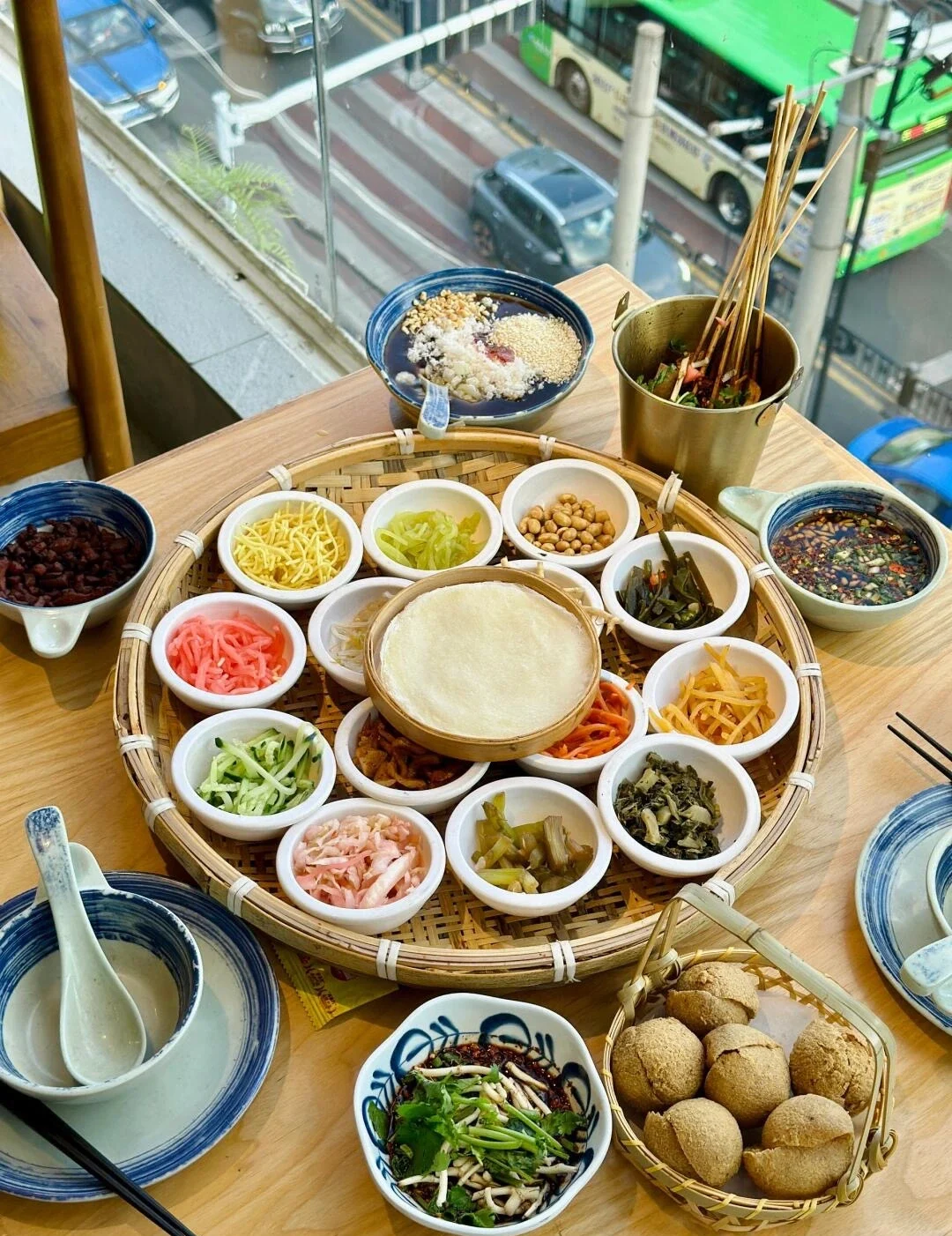
Siwawa (丝娃娃) — one of the easiest local foods for first-time visitors to enjoy. It is light, fresh, and interactive, making it a strong choice if you want local flavor without committing to a heavy or very spicy main dish.
Huaxi beef noodles (花溪牛肉粉) — a comfort-food classic and one of the safest local staples to start with. It suits travelers who want something clear, filling, and distinctly local without jumping straight into Guiyang’s most intense sour-spicy dishes.
Tofu balls (豆腐圆子) — a key snack-layer food rather than a full meal. They are worth trying if you want to experience Guiyang’s street-food side and taste something crisp, casual, and strongly tied to local snack culture.
Night-market snack layer — beyond the headline dishes, Guiyang also makes sense through grilled skewers, small fried bites, cold dishes, and mixed snack stalls. This layer matters because the city’s food culture is best understood across multiple stops, especially in the evening.
Guiyang’s flavor logic
Guizhou Sour Soup Fish Cuisine
Guiyang food is built around sourness, chili, broth, and appetite. Compared with places that rely mainly on oil or numbing spice, Guiyang’s style often feels sharper, more fermented, and more wake-up-the-mouth than simply “hot.” That is why the city works especially well for travelers who like strong flavor but still want freshness and contrast.
Regional differences
Compared with Chengdu or Chongqing, Guiyang flavor is usually less numbing and more sour-driven. Compared with many eastern Chinese cities, it feels sharper, more fermented, and more built around broth, snacks, and appetite-opening contrast. That difference is part of why Guiyang food feels so distinctive even on a short trip.
What to focus on as a visitor
Do not treat Guiyang food like a one-dish checklist. The smarter approach is to combine one sour-soup meal, one noodle meal, and one night-market session. That gives you a much clearer reading of the city than chasing only the most famous name on a menu.
How Much Does a Guiyang Trip Cost?
Guiyang is usually a moderate-cost city by China travel standards. The city itself is not especially expensive, and the core experience—parks, food, short rides, and a few main sights—offers solid value. Costs rise more noticeably when you upgrade hotels, add private transport, or use Guiyang as a base for bigger Guizhou extensions.
Travel style
Daily cost (per person)
What it usually includes
Budget-ish city stay
RMB 300–500
Simple hotel, local noodles and snacks, metro + short taxi rides, core city sights
Mid-range classic stay
RMB 600–1,000
Comfortable hotel, stronger food mix, city transport by metro + taxi, Qingyan or one similar extension
Comfortable city + extension stay
RMB 1,100–1,900+
Better hotel, more restaurant meals, easier transfers, and one larger extension such as Huangguoshu
What affects your daily cost
Staying in the city core is usually good value, especially if you combine walking, metro, and short taxi rides.
Food can stay affordable even at a comfortable level, which makes Guiyang stronger on value than many bigger tourist cities.
Hotel choice matters a lot. Newer business hotels and higher-end comfort raise the budget faster than food or entry fees.
Qingyan is a manageable add-on, but larger extensions like Huangguoshu push up transport and total daily spend much more.
Private cars make the trip easier, but they are one of the fastest ways to raise costs in and around Guiyang.
Overall, Guiyang works well as a flexible, mid-cost city. It is easy to keep affordable, but also easy to upgrade if you want more comfort and smoother day trips.
Guiyang is easiest to enjoy when you use it the right way. Most first-trip mistakes come from treating it like a pure landmark city instead of a comfortable Guizhou base with food, parks, and selected extensions.
Do not judge Guiyang by blockbuster-sight standards. It works better as a cool, food-driven, city-and-gateway stop.
Decide early whether your trip is mainly about the city itself or about using Guiyang as a base for the wider province.
Protect your core structure first: Jiaxiu Pavilion, one park layer, one food layer, and one extension or museum layer.
Do not overload a 2-day trip with Huangguoshu unless you are fully willing to sacrifice city time and accept a long day.
Qingyan Ancient Town usually works better as a half-day or day trip than as a place to stay overnight.
Expect rain, especially in the warmer months. A compact umbrella or light rain layer matters more here than in drier China routes.
Use metro plus short taxi rides for efficiency. Guiyang is not a city where most first-time visitors should rely on walking alone.
Stay central unless you have a very specific reason not to. A strong base in Nanming or Yunyan usually improves the whole trip.
Treat night food seriously. A good evening food session is not optional filler in Guiyang; it is part of understanding the city.
Pack for mixed conditions: breathable layers, a light jacket, comfortable shoes, and something for damp weather.
For most first-time travelers, Guiyang works best as both a short destination and a gateway, but the gateway role is stronger. It is worth 2–3 days in its own right because the city combines cool weather, strong local food, urban parks, and an easier introduction to Guizhou. It is usually less convincing as a long stand-alone city trip.
That is why the most accurate way to use Guiyang is as a comfortable base with real local value, not as a place to rush through and not as a city to overextend. If you skip it completely, you miss an important urban layer of Guizhou. If you expect it to carry a 5-day city-only trip by itself, you will probably ask too much of it. The sweet spot is to treat Guiyang as a worthwhile first stop, then let it open the door to the wider province.
FAQs About Guiyang Travel
Is Guiyang worth visiting for first-time travelers?
Yes, but with the right expectations. Guiyang is worth visiting if you want food, parks, a cooler climate, and an easy entry into Guizhou. It is less suitable if your first-China priorities are only top-tier national landmarks or a city packed with nonstop headline sights.
How many days do I need in Guiyang?
For most first-time visitors, 2–3 days is the right range. Two days lets you cover the city core plus one extension. Three days gives you a more relaxed structure with room for food, parks, and one stronger add-on without turning the trip into a rush.
What is Guiyang famous for?
Guiyang is best known for its cool summer climate, Guizhou-style sour-and-spicy food, city parks like Qianling, and its role as the main transport hub for exploring the rest of Guizhou. It is also associated with Jiaxiu Pavilion and as a starting point for wider provincial travel.
What is the best time to visit Guiyang?
Autumn is usually the safest all-round choice. Summer is also very popular because Guiyang stays cooler than many other Chinese cities, though rain becomes a bigger factor. Spring works well too. Winter is quieter, but less ideal if you want the city at its most comfortable and flexible.
Is Guiyang better as a destination or just a gateway to Guizhou?
Guiyang is better used as a gateway with real destination value. It is not just a transfer stop, because it still supports a strong 2–3 day stay with food, parks, and a lighter urban rhythm. But for most travelers, its gateway role remains the stronger one.
Should I stay in Guiyang or Qingyan?
For most first-time visitors, stay in Guiyang. The city is more practical for transport, food, and building a balanced route. Qingyan works better as a half-day or day trip unless you are specifically looking for a slower ancient-town stay and are willing to trade away city convenience.
Can I visit Huangguoshu from Guiyang?
Yes, you can, and many travelers do. Guiyang is the most practical base for a Huangguoshu day trip or short extension. The key is to treat it as a full-day outing, not something to squeeze into an already packed city day. It works best when planned as a separate block.
Is Guiyang touristy?
Not heavily by major-China standards. Some places, especially Qingyan and the main city sights, do attract visitors, but Guiyang still feels more functional, local, and lower-pressure than many top-tier tourist cities. That is part of its appeal, especially for travelers who want a less overbuilt experience.
Can I visit Guiyang independently?
Yes. Guiyang is very manageable for independent travel. The city has working metro coverage, affordable taxis, clear hotel choices, and enough basic tourism infrastructure to make self-guided travel realistic. With map apps, translation support, and simple planning, most travelers can handle it without difficulty.
I’m Anthony, the founder and editor of The China Journey.
I create practical, experience-based guides covering travel, food, and culture across China, with a focus on helping international travelers make clear planning decisions.
Discover 12 fascinating facts about China’s Terracotta Warriors, from their accidental discovery to advanced craftsmanship, unique designs, and enduring global legacy.
Explore Jiangsu cuisine’s exquisite flavors, featuring signature dishes like Squirrel Mandarin Fish and Salted Duck, known for their artistry and balance.
Explore exquisite Chinese porcelain: ancient craftsmanship from blue‑and‑white wares to famille rose, combining artistry, history, and cultural elegance.
Plan Your China Trip with Our Experts
Share your travel ideas, and we’ll help you plan a smooth, personalized trip across China.
Plan Your China Trip with Our Experts
Share your travel ideas, and we’ll help you plan a smooth, personalized trip across China.
Work with Us as a Local Guide in China
We’re looking for experienced, part-time local guides to serve international travelers.
Requirements:
• Fluent in at least one foreign language • 3–5 years guiding international visitors • Able to operate in multiple regions in China • Competitive and reasonable pricing • Proven customer reviews or testimonials • Professional, reliable, and responsive • Flexible availability for custom trips
Just a quick heads-up — a helpful user named Volker let me know that some of the non-English content on this site may not be accurate.
This site is a one-person project I run part-time. I research and publish all the content myself, and the translations are currently done by machine (Google Translate). Balancing accuracy and accessibility across multiple languages is a real challenge.
If you spot any errors, I recommend switching to the English version using the button at the bottom left. I’ll continue working to improve the translations over time.
I truly appreciate your understanding. And if you have any suggestions, feel free to leave a comment — it means a lot to me.